This article is jointly published with K-UTE Radio as part of collaborative coverage of the 2026 Sundance Film Festival.
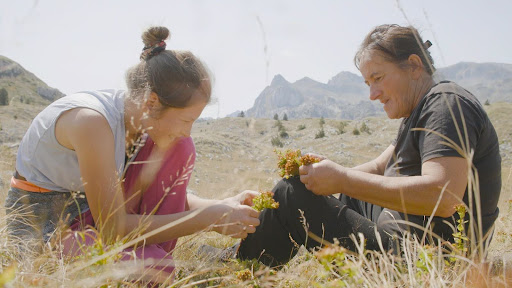
Within the highlands of Sinjajevina reside Gara and Nada, two women who became the subjects of a dramatic storytelling by film directors Bilijana Tutorov and Petar Glomazić.
About the film
“To Hold a Mountain” documents femininity from a perspective of strength and power. The filmmakers rewrite the status quo and take a direction of realizing a woman’s role as a herder and pasteurizer. They added that too often in their culture, stories like Gara and Nada’s are told from the perspective of male warriors; they wanted to change that.
Tutorov and Glomazić realized emotion is a powerful tool for filmmaking, so that’s what they led with. Tutorov described that with this project, they wanted to emphasize the human experience over a call to action.
“Very early on, we decided that we will help the community, but we didn’t want to make an activist film,” Tutorov said. “An activist film never involves you emotionally enough.”
A series of research led them to Gara and her daughter Nada, who continued to be their muse throughout production. And as Gara got herself involved in activism against NATO’s efforts to take over the land for military purposes, it pulled Nada toward a discovery of self and growth.
Shifting focus toward people, not boundaries
The outcome from this film is an “encouraging example” of how society can begin to view land ownership. Sinjajevina is described as the “motherland,” and as mothers like Gara, it is their duty to take care of the land, just as it does for them. This film is a great depiction of that reciprocity and shows that making sacrifices for what you believe in proves successful. It invites hope for a new day. Glomazić and Tutorov agree that to defeat patriarchal thinking, bringing awareness to small communities can provide the answer.
“This film is a process of emancipation and empowering … so it was a kind of very fair exchange,” Glomazić said.
“To Hold a Mountain” focuses on the relationship between Gara and Nada and how their story relates to the over-encompassing landscape surrounding them. While Gara finds herself naturally leading a revolution to save the mountain, Nada recognizes how her past has shaped her present situation and begins to use those feelings to empower herself. Both of these experiences not only strengthen each character but also the bond that ties them together. It was heartwarming to watch them grow closer, already having a strong connection to begin with.
Glomazić and Tutorov described that the details during filming of “To Hold a Mountain” inspired them to focus on the relationship audiences could build with Gara and Nada. The audience got to know these women below a surface level, but just enough, leading you to want to get to know them more.
“I think that we are crossing easily all cultural barriers or differences between different cultures easily,” Glomazić said. “And Gara’s destiny is very universal. Her care, her love, her support, her fight, her courage for the right things, it is something understandable to everyone. And we are all the same.”
More information about the film can be found here.