The 2026 Utah Legislative Session focused on a wide range of bills related to safety, community, society and education. The efforts demonstrate attempts to rework certain policies across the state, extending beyond government into medical, community and educational spheres.
Throughout the session, legislators discussed tighter regulations in classrooms, amendments to Utah’s criminal justice system, substance use and broader individual rights. This article covers highlights from the session.
Safety
In terms of safety, legislators passed a number of bills involving different areas. This year, legislation passed that redefined the terms of open carry on campus, as well as amended the rights of victims of crime.
HB 84, or the Dangerous Weapons Amendments, changed both concealed carry and open carry policies on college campuses. Signed by Governor Cox on March 19, the bill bans the open carry of firearms on campus while lessening the requirements for concealed carry. Now, anyone can carry a concealed firearm on campus without a permit.
The bill’s sponsor, Rep. Walt Brooks, R-St. George told Utah News Dispatch that he would “rather have more people have access to carry on campus, rather than fewer people having more options to carry, when there’s open and concealed.”
HB 137, Violent Crime Clearance Rates, passed from the House to Cox on March 16. The bill focuses on closing unsolved crime cases by providing more resources to law enforcement and justice to the victims of these cases. This bill specifically aims to help those who have been or are being affected by cold cases.
Rep. Verona Mauga, D-West Valley City, said in a committee meeting that she supports the bill. “Too many people are still waiting for answers in cases that have gone cold. That kind of uncertainty is incredibly painful,” Mauga said. “It doesn’t end when the headlines fade. Families live with unanswered questions for years, sometimes decades.”
Another bill involving victim protection services, HB 102 — also known as the Victim Privacy Amendments — was passed onto Cox’s desk. It allows for victims to remove their full names from public databases and allows for more victim privacy in court cases.
The legislature this year extensively deliberated on HB 303, also known as the Family Court Amendments, which lawmakers passed on to Cox in early March. This bill will improve the court processes for cases of domestic violence and commit to keeping children safe throughout the legal process.
Community and culture
Many bills from this year’s legislative session surrounded social issues, many of which related to transgender rights, reproductive rights and substance abuse. Only a few of the bills reached Governor Cox’s desk.
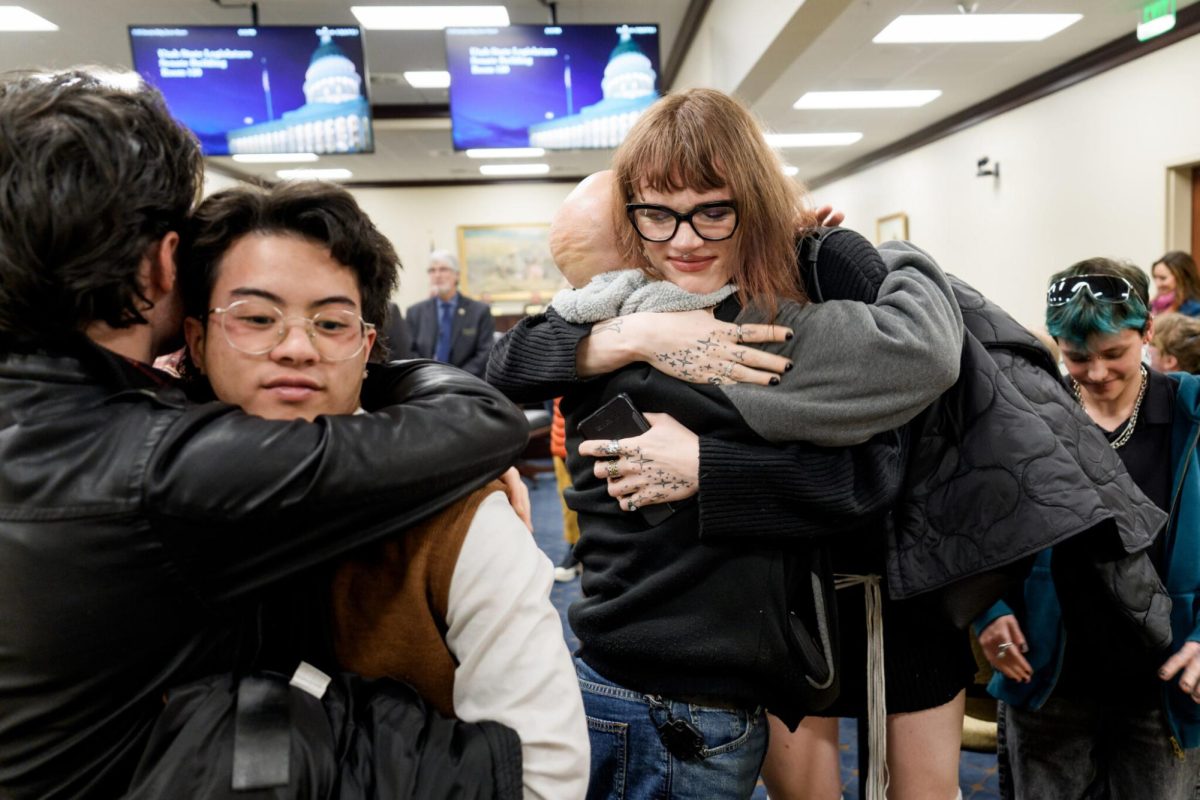
Lawmakers frequently discussed transgender rights throughout this year’s session, considering legislation such as Flag Display Modifications (HB 81), Public Employee Gender-specific Language Requirements (HB 95), Sex Characteristic Change Treatment Amendments (HB 174), Noncitizen Restricted Person Amendments (HB 183), Transgender Medical Procedures Amendments (HB 193) and Insurance Coverage Amendments (HB 258). From these six bills, HB 258 and HB 174 are the only ones that were passed.
Proposed by Representative Nicholeen Peck, R-Tooele, HB 258 requires insurance companies that cover gender-affirming procedures to also cover detransition care. The bill was signed by Governor Cox on March 17 and will go into effect on May 6. However, the coverage requirement only applies to policies being initiated or renewed after Jan. 1, 2027.
HB 174, introduced by Rep. Rex Shipp, R-Cedar City, requires doctors to taper existing patients under the age of 18 off hormone treatments by Jan. 28, 2027. This turns the 2024 moratorium on hormone treatment into a permanent ban. Governor Cox signed the bill on March 18.
HB 315 was also introduced by Rep. Peck. It would have required public schools to show an ultrasound video and a video about human development twice between grades seven to 12 in a health class. The bill would require schools to show a video made by anti-abortion organization Live Action called “Baby Olivia.” The bill did not pass.
HB 205 was introduced by Rep. Tyler Clancy, R-Provo. The bill passed on March 18. It focuses on substance abuse interventions across Utah communities and public spaces. Some of its provisions include implementing recovery housing pods, authorizing the creation of a Structured Treatment and Enforcement Pathway (STEP) program and allowing judges to prohibit someone charged with or convicted of a drug crime from entering a certain area. It would also establish “drug-free zones” to keep dealers out of parks and other public spaces. The bill will go into effect on May 6.
Education
Lawmakers approved the state’s higher education budget. The package includes more than $86 million in new funding. The money will support compensation, growth and workforce programs.
HB 352, a major system alignment bill, also passed on March 19. The measure groups institutions into regional clusters, aiming to improve coordination and efficiency.
In an email statement to The Daily Utah Chronicle, Rep. Karen M. Peterson, R-Clinton, said the bill “focuses on strengthening collaboration across institutions both statewide and regionally to better serve students.”
She said the plan will expand transfer pathways and support joint research and programs. The Utah Board of Higher Education (UBHE) will now develop the framework.
Lawmakers also passed SB 240 on March 19. The measure reshapes higher education oversight and the roles of presidents and boards of trustees. It also increases expectations for accountability and performance.
Other bills targeted student outcomes. HB 353 requires clearer credit transfer systems, and SB 295 promotes intellectual diversity through campus events and debate.
Several proposals did not pass. HB 204 advanced early in the session. The bill would have required accommodations for students with deeply held beliefs. It failed to reach final approval. Other proposals on campus speech and tuition policy also stalled.
Heading into the next year
The 2026 Utah Legislative Session ended with lawmakers passing changes to campus carry laws, funding efforts to solve violent crimes and restructuring higher education. They also approved new substance use policies and regulations affecting healthcare.
Some proposals, including measures on classroom content and student accommodations, did not pass. These laws will take effect throughout the next year, shaping policy across campuses, courts and communities statewide.