

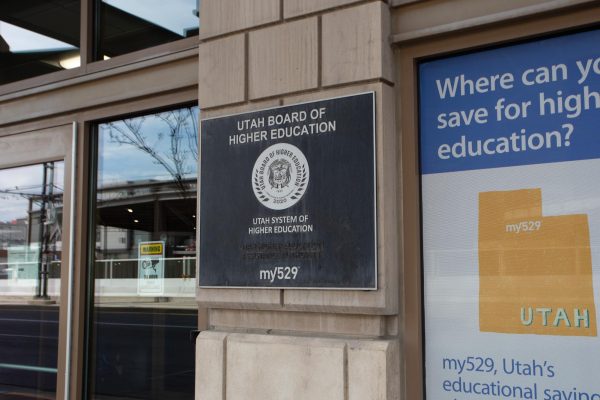
The Utah System of Higher Education (USHE) passed a new workload policy that, starting July 1, will increase teaching loads for some career-line faculty at the University of Utah without additional pay. As the university works to develop a compliance plan, students and faculty are asking what the change will mean inside the classroom.
Lecture-track faculty, who are responsible primarily for teaching, may be disproportionately affected by USHE Policy R485. The policy requires full-time instructional faculty at state universities to teach an average of 24 instructional hours per academic year. Students and professors fear the added workload could strain faculty and affect classroom quality. University administrators disagree, saying they anticipate no negative impact on students.
Outside the classroom
Career-line faculty, specifically those on the lecture-track faculty, may be disproportionately affected by the policy. Unlike professors with research or clinical duties, lecture-track faculty are responsible primarily for teaching and service. Pamalatera Fenn, a student at the U and the ASUU Senate Treasurer, said that the U risks losing skilled teachers if there isn’t also a matching pay increase. “We are going to lose a lot of professors, and the professors we don’t lose, they’re going to be overworked,” Fenn said.
Sarah Projansky, vice provost for faculty and academic affairs, said in an email interview with The Chronicle that the scope of the change is narrower than critics suggest. “Approximately 50% of our career-line faculty already work the equivalent of 24 IHEs per academic year,” she said. “Nothing is changing — for faculty or students — in those units.”
Dr. Harriet Hopf, a professor of anesthesiology and former Academic Senate president, said each course entails significant work beyond the classroom. “Each course has a halo of all the other work that gets done for the course,” Hopf said. “So preparing, teaching, supporting students, grading students, writing exams or assignments, sort of all of that stuff.” That “stuff” is hours upon hours of work. Now tack on another course, and it will affect the amount of support teachers can offer.
Projansky said faculty expectations remain unchanged. “Expectations for faculty have not changed — they are expected to develop their courses, including grading, in a way that helps students meet the learning outcomes. Nothing in that will change, and so there should be no negative impacts on student outcomes.”
In class
For faculty who take on an additional course, Hopf said the added time commitment will have to come from somewhere. “They have to add more time to not being with their family or not eating or whatever; not exercising, right?” Hopf said. “They either have to cut into their well-being time, or they have to cut into their preparation for class time … they have to figure out where the time is going to come from to give that same effort to another class, which might mean less effort to all classes.”
Hopf said that such is very dependent on a professor’s classes in a semester. For professors who do have to pick up an additional class, the attention they can give to each course — and each individual student — may inevitably thin out. For some classes, such as smaller courses where attention can make a real difference, the impact could be significant. “It’s kind of like when your mom has another kid,” Fenn said. “Your family’s bigger now, but now mom has to spend all of her time with all four kids instead of just all three.”
On whether smaller or discussion-based courses would be disproportionately affected, Projansky said the concern was unfounded. “Workload distribution has nothing to do with enrollment levels. If anything, an increase in the number of sections we are able to offer may make it easier for us to maintain more (appropriately) smaller-sized courses.”
University communication
When asked whether student leadership had been consulted during the planning process, Projansky said the matter had been raised at the Academic Senate. “This has been discussed at the Academic Senate several times, and the student senators — who are ASUU leaders — have had an opportunity to communicate their thoughts in that context,” she said.
Projansky said a broader communication to students is not planned. “Because the number of courses our faculty teach and the workload assignments that our faculty have are not generally communicated to students, we do not have a plan to communicate about it now.” She added that individual departments or colleges may choose to notify students if they determine the change will be visible or impactful.







Maximilian Werner | Apr 10, 2026 at 5:15 pm
Where does one begin addressing these baffling statements made by administrators? Let’s start here:
“Students and professors fear the added workload could strain faculty and affect classroom quality. University administrators disagree, saying they anticipate no negative impact on students.”
On what basis do administrators disagree? And who is in a better position to say there will be negative impacts on students? Administrators with almost zero understanding of what happens in the classroom, or the people who teach and learn in those classrooms?
Projansky says, “Approximately 50% of our career-line faculty already work the equivalent of 24 IHEs per academic year,” she said. “Nothing is changing — for faculty or students — in those units.”
Maybe not, but what about the other 50% of career-line faculty, those who teach the high-contact classes and whose workload may increase by as much as 33% without additional pay? Would Projansky accept a 33% work increase without compensation? Would anyone in the Park Building? The logic of this statement is baffling. Someone please explain it.
Projansky said faculty expectations remain unchanged. “Expectations for faculty have not changed — they are expected to develop their courses, including grading, in a way that helps students meet the learning outcomes. Nothing in that will change, and so there should be no negative impacts on student outcomes.”
Expectations may not have changed, but the means, i.e., the time and energy, to meet those expectations are what are what will invariably change. A lot of things “should be,” but the reality of what IS means that these uncompensated increases, together with higher course caps, among other things, are necessarily going to further strain an already overworked and undercompensated group of faculty. The Park Building does not seem to realize, or care, that everyone is going to be negatively impacted by this short-sighted interpretation of R485.
Jay Jordan | Apr 7, 2026 at 12:49 pm
(My opinions only–not those of my department or any other unit in the U.)
Yet one more instance of a decision being made among a small group of administrators, who then require faculty members to figure out the impacts and how to redress them. “Consultation” with faculty has been a series of meetings/town halls in which the policy has been broadcast and in which serious concerns have been met mostly with nods and shrugs. There has been little meaningful change in response to consistent faculty feedback.
And now administrators are delaying the release of their approval/disapproval of individual department workload policies. Projansky reiterates here that departments have the ability and responsibility to work it out and to communicate with students, but as of APRIL, departments don’t know what their individual policies can even BE. Department-level decisions about Fall teaching need to have already been made. So any changes that occur now will have to be handled over summer–including communications with faculty who are right now waiting to learn whether they will need to teach more sections.
The lack of connection between administrators and faculty is a chasm.