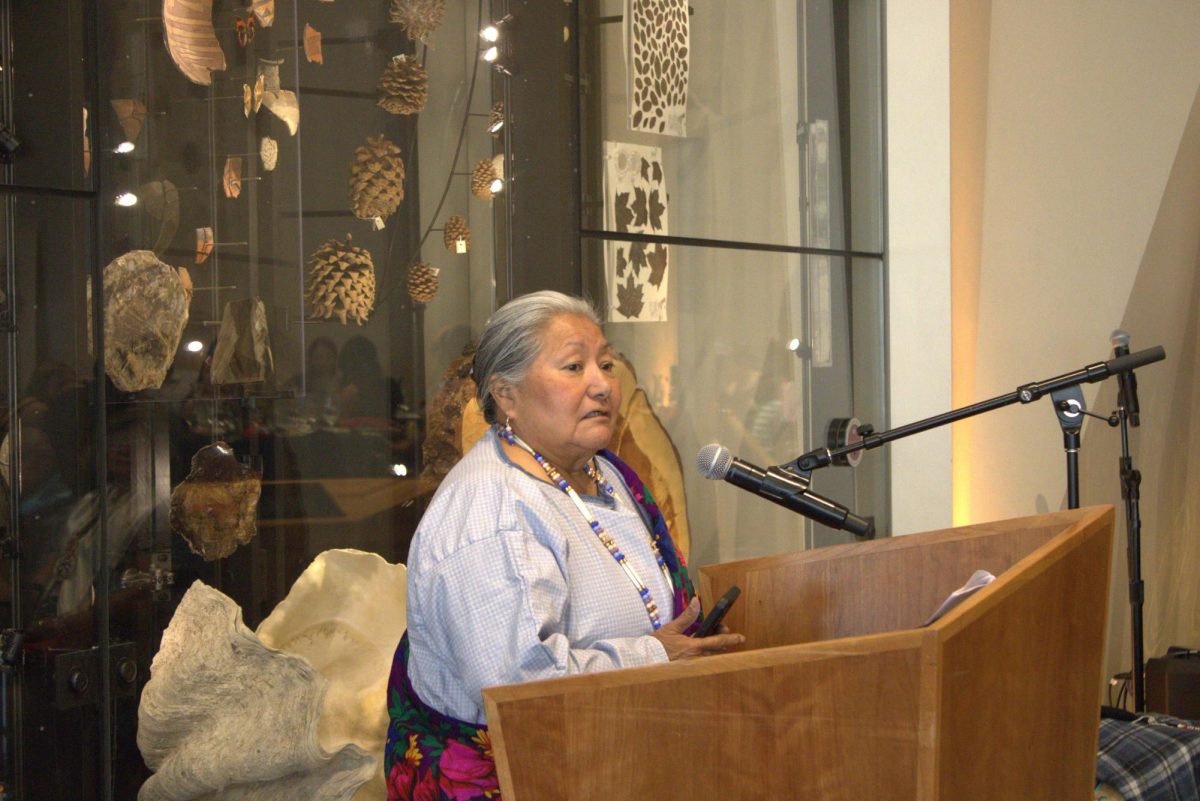
Hosted at the Natural History Museum of Utah on June 25, the Center for Native Excellence and Tribal Engagement brought together Tribal Nation heads of state, members, educators, students and activists to celebrate leadership and achievement within the indigenous community.
Taking place on the 30th anniversary of Native Excellence, the center works to increase the recruitment and retention of American Indian students at the University of Utah, as well as raise awareness of culture and community on campus and beyond.
Dakotah Bitney, member of the Navajo Nation (Diné), explained to the audience how Native Excellence plans to honor the “Changemakers and Knowledge Keepers” of indigenous communities. A Changemaker, she said, is “someone who creates meaningful, lasting positive change through service, leadership and action,” whereas a Knowledge Keeper is “someone entrusted with preserving and sharing cultural knowledge, language, teachings and traditions.”
Tia Wood sings on the power and complexity of native identity
Keynote speaker Tia Wood of the Saddle Lake Cree Nation spoke and sang about her experience as an indigenous woman and vocalist. “[Since I was a child] there was no doubt that my parents knew what it was they needed to do to nurture the path before me,” she said in her speech.
Wood’s inspiration came from both colonial and native artists., “I would challenge my vocals from the riffs and beats of the early music of Avril Lavigne, Lauren Hill, Amy Winehouse and Bob Rattles and because that was all [that was on] the radio in my rez,” she said. Woods’ parents are both musical performers within her tribal nation – during her speech, she said their music and influences helped shaped her passions.
Knowing that she wanted to be a singer, even then Wood understood it would be a difficult path.“I always had this dream inside my heart, inside of my spirit, that I wanted to be a singer,” she said. “Growing up at the time, it felt a little difficult to dream like that because I think there’s always a lack of representation when it comes to indigenous people.”
Despite the obstacles, she persisted. As a musical artist, Wood has traveled across the world, getting her “boots all across North America” and parts of Europe, India and New Zealand. “Growing up, I wasn’t able to turn on the radio and hear someone that sounded like me,” she said. “I think we’re in such a beautiful time right now … Like we’re at the brink of the iceberg when it comes to indigenous representation. We’re able to turn on the TV now and see people like us, like with Reservation Dogs … and now we have our models coming down the runway.”
The shifting voice of youth
Emeline Natchees Root, a member of the Navajo Tribal Nation (Diné) recognized as a Knowledge Keeper, spoke about the difficulties of attending university as a Native American. “It is a really hard thing to leave your families, leave your reservations, leave your comfort zone and enter an environment that is really totally different from where you grew up,” she said. “Our students do need that support.”
During her award speech, Root spoke about the importance of keeping their culture. “I’m so honored that our grandparents or great grandparents, people that came before, that they kept our traditions, they kept our languages, they kept the way we are connected in this world,” she said. “I do my best to pass that on to the young people.”
In an interview with the Chronicle, future U student Dowawisnima Groves said that her awards and scholarships will make the transition to the U easier to manage. Groves received two scholarships, one of which will allow her to live at the U with her sister in the Native Ascent House.
After she graduates, Groves wants to be an art teacher. “I can create a space for native students living in urban areas to kind of feel community in their non-native schools,” she said. “Art has been my greatest connection to my culture, living in a non-native area. My way of giving back would be to become an art teacher.”
Sienna Reyes, now a sophomore at the U, received the American Indian Ambassador Scholarship. Reyes was grateful to her family and what they sacrificed in order for her to attend college. “I plan to attend medical school,” she said. “That way, I can [learn] urban knowledge from the books and from people, so my community has that [too].”
Community connection
In an interview with the Chronicle, Director of Native Excellence Samantha Eldridge said that she’s happy with the impact Native Excellence has accomplished. Eldridge was a first-generation, low-income student when she attended the U. “When I was growing up, there was a time when it was like you’re living in two roles: you put on your moccasins when you go home and then you take off your moccasins when you go to school,” she said. “You kind of had to live in two roles, and that was hard to navigate.”
Eldridge said that her advice for youth would be to sit down with their elders and hear their stories, as they won’t be around forever. “All of the things that I wish I had when I was a student I get to dream of and get to do [for students now],” she said. “Our center provides that space where they don’t have to separate themselves from their culture, from their families, from their identities. They can be proud of who they are and where they come from, and know that they also make a meaningful contribution to the University of Utah.”
Eldridge said that their events are open to all students. “We really invite anyone who wants to learn more about what we do, anyone who wants to engage in our events throughout the year, to just come and hang out with us.”
In her speech, Bitney said that the center is an experience like no other. “Being able to hold space in an environment like that with indigenous people is something truly special,” she said.