This article originally appeared in the Resolutions print issue, in stands February 2026. It has not been updated and some information may be out of date.
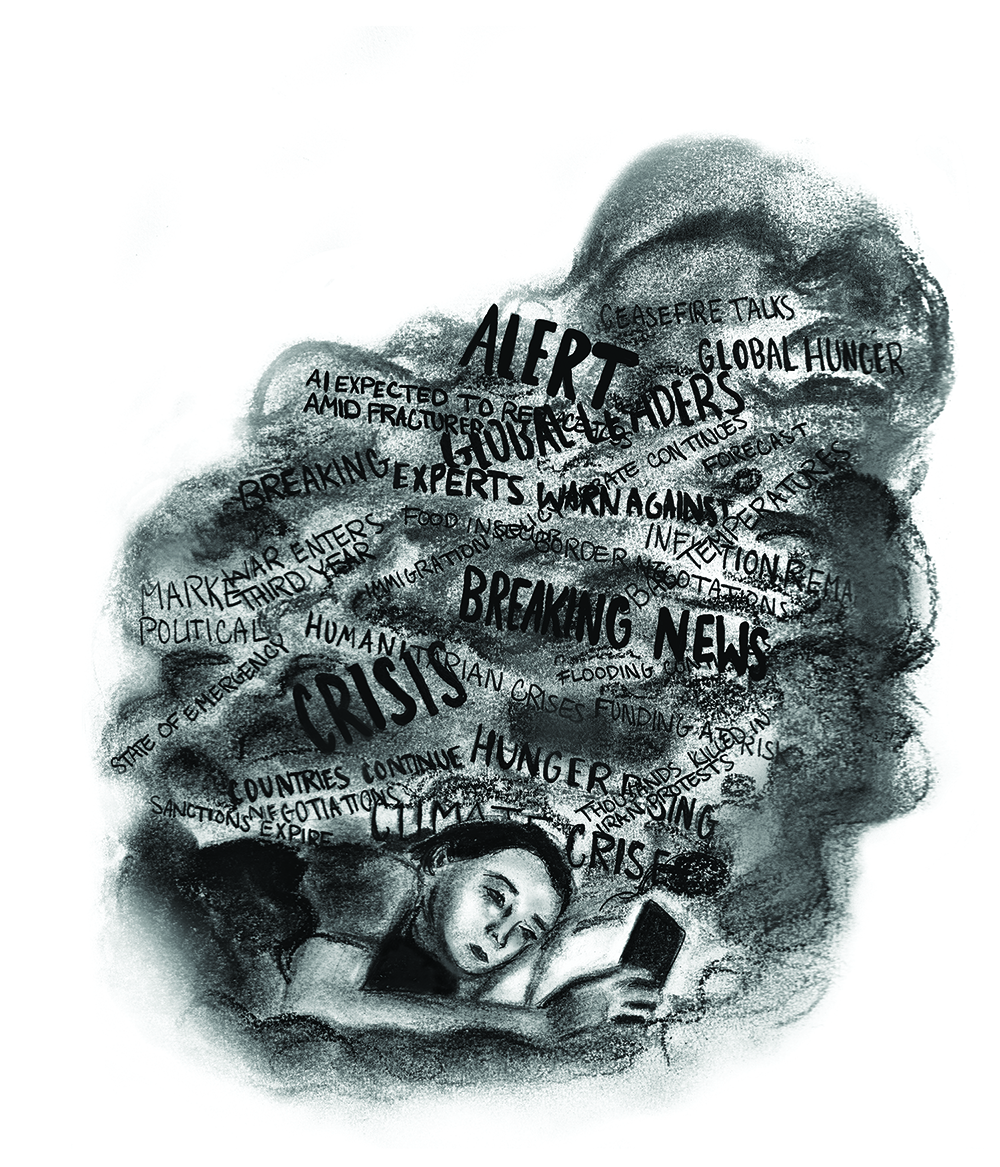
Despite the constant flow of easy-to-access headlines, fewer Americans are following the news than ever before. As news floods social media feeds, radio stations and TV channels, many audiences become overwhelmed by the quantity and nature of the information they consume.
Constant exposure contributes to a growing sense of news burnout, leading some people to even disengage from current events altogether. The emotional weight of nonstop negative coverage raises questions about how audiences can sustain healthy interaction with the news.
According to the American Psychological Association, constant exposure to news headlines can have negative effects on mental health. Recurring headlines can lead to feelings of “hopelessness and depression,” and since “the bad news seems to be coming from every angle … it can be very overwhelming.”
In an interview with the Chronicle, University of Utah journalism professor Glen Feighery discussed the importance of staying up-to-date on current events. “As a former journalist, as a journalism professor, as a citizen, I want to be informed. I feel that I have to [be],” he said.
Another U journalism professor, Jake Nelson, described factors contributing to news avoidance despite the importance of staying informed.“People feel very helpless when they consume news … Even when it’s not making you feel bad about the world, the news can be very boring or mentally taxing,” he said. “It just feels like more work to do on top of the work that we already have to do.”
Life online
One major contributor to American news burnout is social media. Half of American adults surveyed by the Pew Research Center sometimes get their news from social media. Online outlets often embed news into their daily algorithms, making headlines often unavoidable. According to Psychology Today, constant consumption can actively contribute to high levels of stress and emotional exhaustion.
Feighery said that social media algorithms are a part of the problem. “I’m not sure if we know if [people are] burnt out on the news, or if they’re just burnt out on all of these news-like things that are shooting at them,” he said.
Algorithms sometimes prioritize the constant, unavoidable stream of headlines to keep people engaged on the app. “Is it even news? Or is it commentary and criticism that appear on people’s phones because an algorithm puts them there?” Feighery said.
According to Nelson, it is “impossible” to determine whether the cause of news burnout can be attributed to the news itself or the way in which it is presented. “So many of my students are learning about the world from social media, which often means they’re learning about the world not necessarily from professional journalists, but from content creators and influencers and people who don’t have that background, but are still nonetheless playing this role in telling them what’s going on in the world around them,” Nelson said.
Staying in extremes
According to Nelson, consuming news, especially from social media, is all about balance.
“If someone decides they’re going to just stop getting news because it makes them feel bad, at a certain point, they will have a less clear idea of what’s going on around them than somebody who’s spending more time with news … I feel like it’s not really that constructive, and it’s also not very empathetic to blame that person for checking out,” he said.
Nelson said that the public is not always to blame for the cycle of news burnout and avoidance. “I don’t like the idea of putting the blame for this issue on the public. It’s better to put the blame for this on [the] journalists’ organization,” Nelson said. “I think journalists [should] basically put themselves in the audience’s shoes as much as possible and think about … what [they] can do to make life easier for those that want to follow what’s going on in the world, but also don’t want to just feel bad.”
How to stay healthy
When asked how people can balance staying informed while also protecting their mental health, Feighery highlighted the importance of focusing on the positives. “Some news is good, and legitimately good, because people are kind,” he said. “We tend to lose sight of that.”
Sometimes, readers must simply take a step back from constant consumption, Feighery said. “Nobody can stay totally engaged all the time. Taking a break is good, and it can help you stay more engaged without being overwhelmed and pessimistic.”
Readers must stay aware of their own emotional fatigue and respond accordingly, Feighery said. “Balance the bad [news] with the good [news].”