Utah’s newly redrawn 1st Congressional District has its first Democratic primary coming up on June 23. In a district where a democrat will likely win, this primary may decide who wins the seat in November. The University of Utah sits in this district.
The field consists of Nate Blouin, Michael Farrell, Liban Mohamed and Ben McAdams. Mohammed won the democratic convention on April 25.
There are no incumbents running in this election. This is partially due to a recent redistricting by Utah’s third Judicial District Court. These boundaries will be present from 2026 to 2032.
The Republican convention back in April chose Riley Owen to run for the seat in the general election in November. Neither Mohamed nor McAdams responded to a request for comment.
Voting
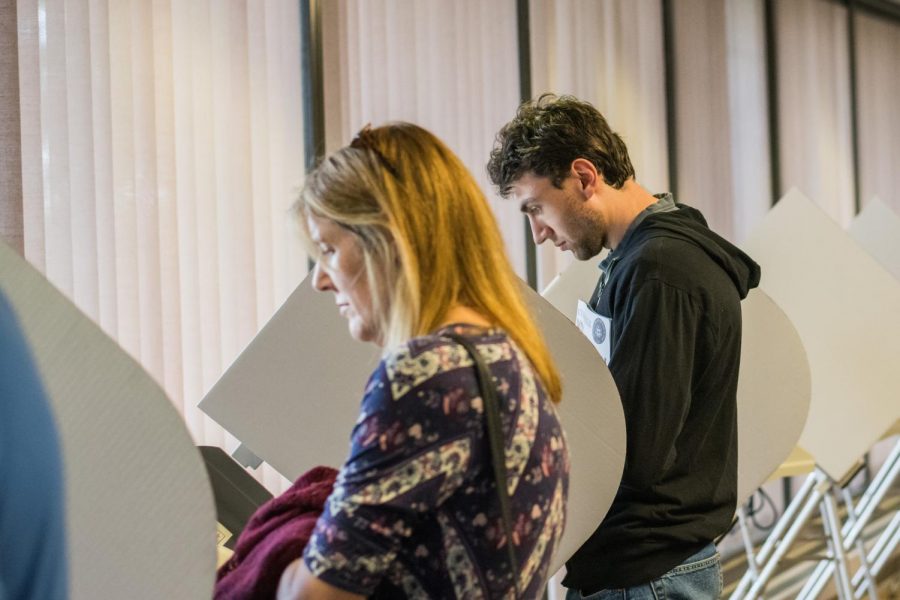
Voting can be done by mail or in person on June 23. The polls will be open from 7 a.m. to 8 a.m. Valid identification is required, such as a driver’s license. Democratic primaries are open primaries, meaning that you can vote regardless of political affiliation.
Same-day registration is also possible at the voting centers. Salt Lake County requires two valid forms of ID that show identification and proof of residency, according to the Salt Lake County website, such as a Utah driver’s license and a paycheck from your employer.
For students living away from home, vote.utah recommends registering one;s permanent residence, which can include a home or school address.
Nate Blouin
Blouin won Utah’s senate race in 2022, representing District 13 in Salt Lake City. Before that, he worked as a renewable energy advocate. Recently Blouin has been criticized for online derogatory comments made from 2009 to 2015 that surfaced during this race.
Housing Affordability
Blouin said that rising rent prices are due to “large landlords using the same algorithms and AI tools to set their prices.” He additionally is against the Faircloth Amendment, saying he wants to repeal “the federal rule that effectively blocks us from building new public housing.”
Blouin cited the bills he’s backed in the US Senate that protected renters, saying “I’ll fight for… proper notice before a big rent hike, an easier path out of a lease, and an end to the punishing eviction penalties that trap renters in debt.”
Great Salt Lake
Blouin referenced SB250, which would distribute water to the Great Sale Lake. “I ran legislation to save [the Great Salt Lake] every year I was in the Senate,” Blouin said, “including a bill to set an official target elevation of 4,198 feet, the minimum scientists say the lake needs.” The bill never left committee.
“I’ll be honest about where the water goes,” Blouin said. “The large majority of it goes to agriculture, and a huge share of that grows alfalfa, much of it is shipped out of state.” Blouin said that eminent domain, which is the power of the government to seize private property and use it for the public, could be used. “Nothing should be off limits,” Blouin said, “when a drying lake threatens the health and economy of everyone along the Wasatch Front.”
Data Centers
Blouin said that he’s called for a moratorium on data centers, “we need a serious national conversation about what we are building before this technology becomes impossible to undo.” He said that beyond the ecological risks, there are also privacy and surveillance concerns. Blouin was the chief sponsor of SB318, which would have prohibited some non-disclosure agreements between data centers and state and local governments.
Blouin said that while he opposes the Stratos Project data center in Box Elder county, “the communities that host them should see real benefits, like good jobs and lower bills, not just the pollution and the water loss.”
Michael Farrell
Farrell says himself he’s not a career politician. He works as a tax attorney for Kirkland & Ellis, an international law firm. Beyond House District 1, Farrell is also running for the Utah House of Representatives for District 23, which at the U consists of everything south of Mario Cappecchi Drive.
Housing Affordability
Farrell said that he’d push for federal assistance into affordable starter homes, “a down payment assistance fund for $25k to first-time homebuyers, and a renter’s tax credit so that renters can save more money to someday buy a home.”
Great Salt Lake
Utah currently has a “use it or lose” limitation on water rights, which Farrell would like to see changed, he said. Because “85% of water usage in Utah is from agriculture,” this could significantly drop agricultural water usage that is unnecessarily being used, he said.
He would also push for “a tax credit to convert residential lawns to less-water-intensive xeriscaped or zeroscaped yards.”
Data Centers
Farrell said he’s opposed to any data centers being built in Utah. “We can’t afford to lose the water needed for data centers and we can’t afford the pollution that would be produced by them.” He specifically mentioned the Stratos Project data center.