

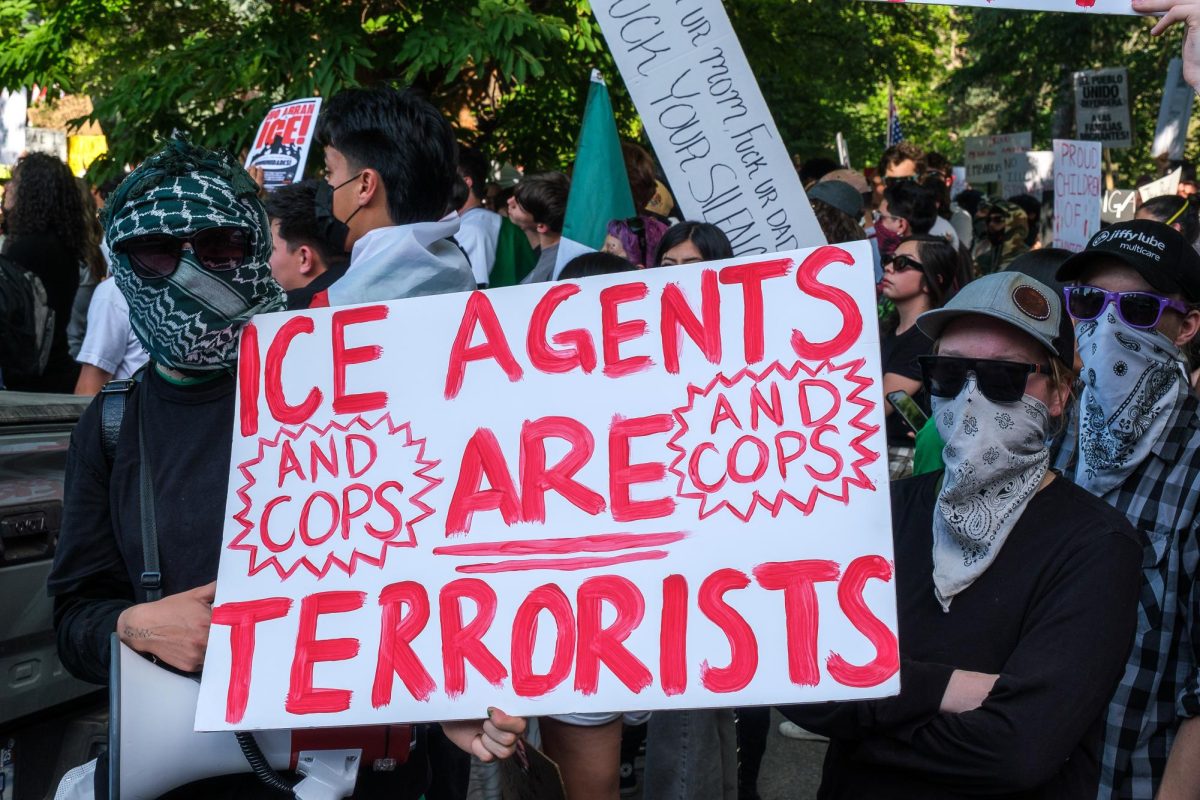
On June 14 of this year, the “No Kings” Protest in downtown Salt Lake City boasted 10,000 protesters. The sea of civilians peacefully marching consisted of a large variety of organizations, families and activists unified by one common goal.
One of these activists was named Arthur Ah Loo. Ah Loo cared deeply for his community and used his talents of fashion design to support others.
As an essential member of Utah’s Pacific Islander community, his family extended beyond his wife and two children. When he was shot at the “No Kings” Protest, Utah lost a leader for love, compassion and selflessness.
His death echoes a continued warning against the dangers of assault-style firearms in public spaces manufacturing fear.
Falsified protection
Ah Loo was shot and killed by a handgun from a volunteer peacekeeper attempting to disarm a perceived threat. The threat was an AR-15.
Arturo Gamboa, another protester, according to witnesses, appeared to be manipulating an AR-15. The assault rifle instilled fear in both witnesses and volunteer peacekeepers.
This fear turned violent, when shots were fired from peacekeepers after witnessing behavior they deemed detrimental for the peaceful protestors. In the chaos of peacekeepers attempting to neutralize this perceived threat, Ah Loo was accidentally shot and killed in the crossfire.
Although Gamboa’s attorney claims he didn’t break the law and the rifle was not loaded, the firearm still incited fear that spiraled into the death of an innocent civilian.
Gamboa’s friends claim that his previous use of assault rifles in peaceful protests was to protect from counter-protesters. Boasting an unloaded AR-15 isn’t a productive way to protect.
Instead, it escalates fear.
This makes decisions extremely difficult for law enforcement as they determine charges. As of July, the Salt Lake City Police Department (SLCPD) is still working to determine a case.
The “No Kings” protest highlights the paradox of seeking safety through assault-style firearms. In public demonstrations, assault rifles incite fear, undermine peaceful protests and endanger innocent civilians.
Assault rifles in legislation
Unloaded assault rifles and other firearms blur the lines between protection and threat. Even placed in hands steadied in good intention, these types of firearms in public are intimidating.
Utah Code, Title 53, Chapter 5a, § 102.2 (2025) permits anyone above the ages of 21 to openly carry any firearm on a “public street” or “any place not prohibited” by law. One is not required to have a permit of any kind.
This code solidifies the impacts of HB60, the Conceal Carry Firearms Amendments establishing permit-less carry in 2021. The recent Utah Legislature has continued to prioritize firearm freedoms, rather than prevent fear.
This code legalizes carrying guns without permits. Although it purports to “effectuate the Second Amendment” and protect infringement on Utahns’ firearm rights, it ultimately leads to greater uncertainty.
Openly carried firearms including assault rifles and shotguns are legally permitted at parks, public streets, parades and any other areas not deemed private by law. This code was finalized barely a month before Ah Loo’s life was taken at the “No Kings” Protest.
His death is the most painful proof of Utah’s shift in legislature and politics. When lawmakers focus too closely on protecting firearm rights, they abandon their actual citizens.
The legalization of AR-15’s and other serious firearms in public spaces, like protests, disrupt public order and safety. Utah must reevaluate its scope on open carry laws.
The current overprotection of open carrying assault-style firearms infringes on the public’s right to feel safe. Now, even more loosened assault-rifle laws have arrived at the U.
Assault rifles and U
While Utah had allowed permit-less carry for anyone 21+ since 2021, the original language in the code and campus rules had previously blurred the lines of its application at the U. Now, HB 128 from the 2025 Utah legislative session has since clarified that Utahns 18+ with a Utah concealed carry permit may carry on higher education campuses. The U has confirmed that this means permit holders may now carry openly. And in Utah Code §53-5a-102, the Legislature “occupies the whole field” of firearm regulation, so the university cannot make stricter firearm policies than state law.
This is extremely unsettling, as college campuses have historically been faced with gun violence.
Recently in 2023, Utah’s neighboring state, Nevada, fell victim to a mass shooting that killed three of its faculty at University of Nevada Las Vegas. Whether open carry firearms are loaded or unloaded, it is far too difficult to discern whether an individual holding an assault rifle is exercising his rights or intending to cause harm.
Utah legislators must recognize how various environments require different firearm protections. The U is a high stress environment for is young students.
As enrollment quickly increases, reaching 37,000 students, so does the risk of fatality. Both faculty and student body must now face the reality that firearms could be present legally and possibly used illegally at any moment.
Utah’s developing open carry policies, while rooted as a protection of rights, shift the burden of safety onto students and faculty who are here for education. It is not our responsibility to assume firearm violence by simply choosing to attend the U.
It is also not our responsibility as citizens of Utah to police firearms in public spaces. As both students and civilians, we must pressure our lawmakers to recognize that protecting the right to carry cannot cost us the right to feel safe.







Baba | Sep 11, 2025 at 5:42 pm
This did not age well
Tayler | Sep 10, 2025 at 4:28 pm
ironic