
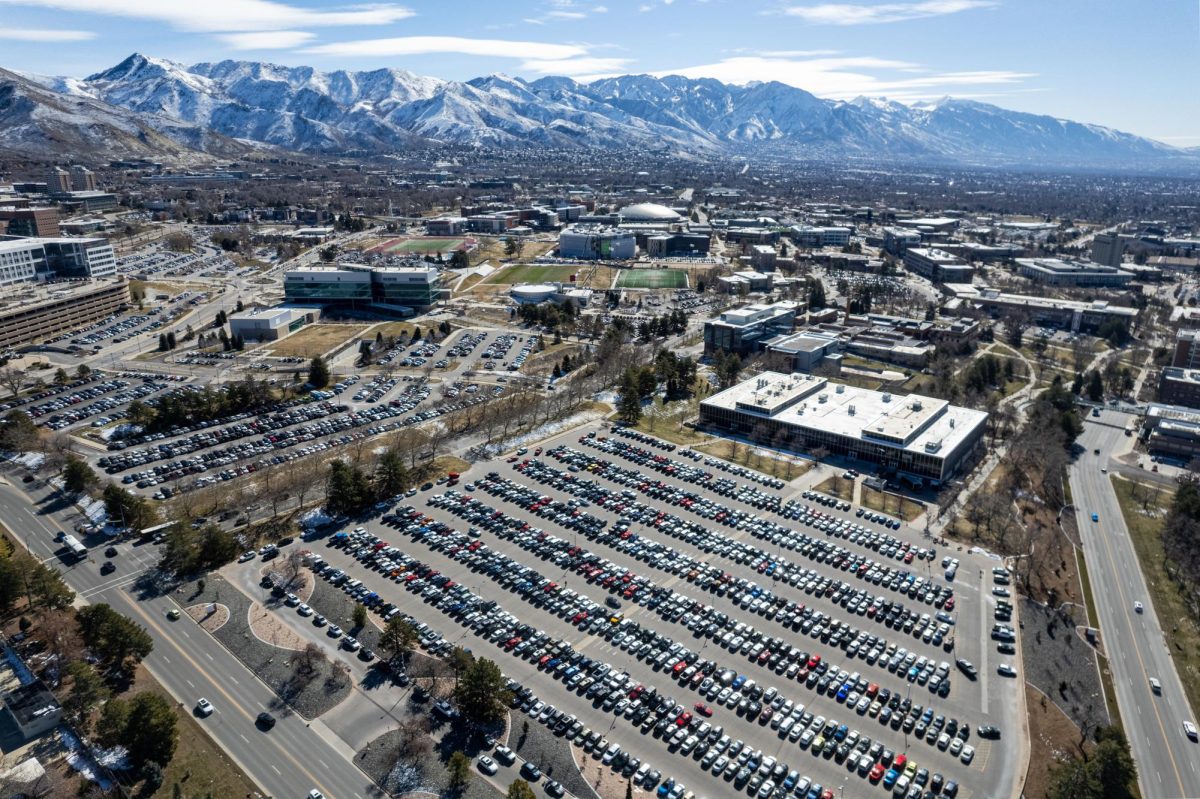
The administration still has not explained why the issue was first announced on Instagram as a fix for the university’s parking problems. This comes at a school where 85 percent of students commute 24 miles or less to campus
The first time students at the University of Utah learned about the changes the administration is making to the class schedule was through an Instagram post on Aug. 28 with the caption “so, about parking.” These changes will move some classes outside of primetime hours (9 a.m. to 2 p.m.) so that by the fall of 2026, at least 40 percent of classes will be scheduled outside these hours.
After a negative reaction from students, including a petition to reverse the decision, the administration made another post claiming the motivation behind the change. “The real motivation for us is improving student success,” the post said. “Better scheduling helps students complete their degrees on time, which reduces tuition costs and allows them to enter the workforce sooner.”
The changes
The administration is mandating that at least 40% of classes be scheduled outside of primetime hours. This is in order to address the problems arising from an uneven distribution of classes.
According to a memo released by Provost Mitzi Montoya’s office, this uneven class distribution creates scheduling bottlenecks that prevent some students from taking required courses on time. It also limits flexibility, delays graduation — increasing debt — and worsens campus congestion, including crowded parking lots. Montoya herself declined to comment.
Our goal is to ensure every student has access to the classes they need to graduate,” Montoya said during a town hall hosted by Associated Students of the University of Utah (ASUU) in September. This is part of a broader initiative called “Mission-Aligned Planning” (MAP), which aims to use university resources more efficiently to further the goals of Strategy 2030. It aligns with President Taylor Randall’s goal to improve the U and make it a top 10 institution.
“The course scheduling project is a part of MAP because it uses data and newly developed interactive dashboards to support deans, department chairs and scheduling staff in making informed, real-time decisions,” Vahe Bandarian, the Associate Provost for Mission-Aligned Planning, said. “By visualizing scheduling patterns and potential conflicts, academic units can ensure students have better access to the courses they need to graduate.”
Faculty and student concerns
Students and faculty say the new scheduling plan adds strain to already packed routines. “Change is hard. Being a student while trying to work or do things outside of school can be a challenge,” said Brittany Badger, director of Student Wellness. “For nontraditional students who rely on more set schedules to balance full-time jobs or family obligations, it just adds another barrier.”
Erik Bond, the vice chair of the ASUU Legislative Assembly, says the changes will affect students and faculty alike. “By spreading out classes out of primetime hours, not only do you put a strain on students who need to work to afford college or other living expenses,” Bond said, “But you also restrict a professor’s ability to work on the research that their RTP [Retention, Promotion and Tenure Standards] may be tied to, or that their job in general may be tied to.”
In September, ASUU hosted a town hall where concerns were voiced to administrators about the changes to the new scheduling. Many of the concerns brought up during the town hall centered around the lack of input from students and faculty on the change. “It just seems like the input from students here was indirect,” math undergraduate and Mecha member Brenda Gaspar said during the town hall. “You guys didn’t talk to us directly. You guys didn’t speak to us, so the first time students learned about this information, it was through a blog post. And that reasonably upset students.”
Paul Kohn, the Senior Vice Provost for Strategic Enrollment, responded. “I’m under the very distinct impression that the student body president was part of the Board of Trustees when this concept was presented to them months and months ago.” Alex Rose, the Student Body President, didn’t respond to a request for comment.
Student experiences
Some students are worried about how these changes will impact their schedule. “If you’re a student who works a job with set hours, and it’s very difficult to have flexibility. How does an 8 a.m. or a 6 p.m. help you succeed?” Amelia Mendez, a student at the U, asked during the town hall.
Montoya urged students to look at their schedules before panicking. “The schedule wasn’t even open when students were signing a petition to undo something. So, now that the schedule is open, I would ask everyone here to look at the schedule and see if you were able to get what you need,” Montoya said at the town hall.
Now that the spring schedule is open, students are already noticing issues with class availability. “I was looking at the classes that I want to take [next semester] and figuring out what times they fit in,” said Naomi Parnell, an undeclared undergraduate student. “The classes that I wanted were all from 7:30 a.m. to 9 or 10 a.m., and then starting at 2 p.m. and going to 8 p.m. I could not find any classes in the middle of the day or very many that were Monday, Wednesday and Friday.”
These later classes could also cut into students’ social lives. “I’m not quite sure how it’s tied to student success because it’s no secret that college kids like to stay out late,” Parnell said. “It doesn’t quite make sense to me why they are pushing for earlier classes and later classes when people want to be spending time with their friends.”
About parking
The administration referred to an FAQ emphasizing the policy wasn’t just about parking when asked why the change was announced as a parking fix. “It’s true that when all courses take place in the same narrow window of time, that places stress on infrastructure (including parking). The real driver is student success,” the FAQ said.
This lack of sufficient parking spots on campus during primetime hours, coupled with a loss of parking lots and an increase in parking pass prices, has led to frustration surrounding parking at the U. “Trying to market [class scheduling changes] as a parking issue was a massive mistake on the administration’s part,” Bond said. “And it wasn’t pitched as such to the student government when some of our higher-ups were being briefed. And apparently, the administration of the U doesn’t know why the marketing for it was framed as such, as that’s not the issue it’s trying to solve.”








A.M. | Nov 14, 2025 at 9:53 pm
The schedule is awful.