University of Utah researchers gathered on May 27-28 for a two-day workshop that focused on using secure cloud technologies to protect sensitive data and understanding how AI functions in academic research.
The Office of the Vice President for Research Security Office hosted the event in partnership with Amazon Web Services. The event introduced faculty, researchers, scientists and IT professionals to tools designed for data-intensive research with AI. There were presentations, demonstrations and hands-on workshops where attendees learned how to use AI tools to automate work and meet federal compliance requirements.
Research through security and compliance
The workshop aimed to help researchers understand how these technologies can support both innovation and compliance. “We are in a new, great new world,” Dr. Erin Rothwell, the vice president for research, said. “Things are going to be more data-intensive, more AI-enabled, and more highly collaborative, and so with that, it is going to be more highly regulated.”
Rothwell said research security is becoming a large part of maintaining a federal research portfolio. “If you want to stay competitive for federal grants, you need to have a real research security office,” she said.
The workshop helped researchers navigate requirements surrounding unclassified information, protected health information, data and other regulated research materials. The event also introduced researchers to the U’s secure research environment, which supports compliance through NIST, HIPAA, FISMA and CMMC standards. “If there’s one message that I believe helping you guys leave today,” Rothwell said, “the secure path should be clear. You should be able to walk away and know exactly what you need to do for the type of research you’re doing.”
Building a secure research environment with AI
The event focused on the U’s partnership with AWS and its transition toward cloud-based research infrastructure. Lisa Young, research security officer, said the move was made to support research and meet security expectations. “If we didn’t [move], then we were at risk, and we’d lose the ability to do this amazing research that was very important,” she said.
According to Young, there was an advantage of AWS-regulated research, which created a shared responsibility for security. “Out of the 287 controls, 143 of them we inherit from AWS,” she said. “They’re already baked into their infrastructure, and then the University of Utah is responsible for the rest.”
The Research Security Office works with technology and compliance teams to simplify the process for researchers. Young described the approach as “one front door” to giving researchers compliance requirements, data and secure resources into one system.
Exploring AI research tools
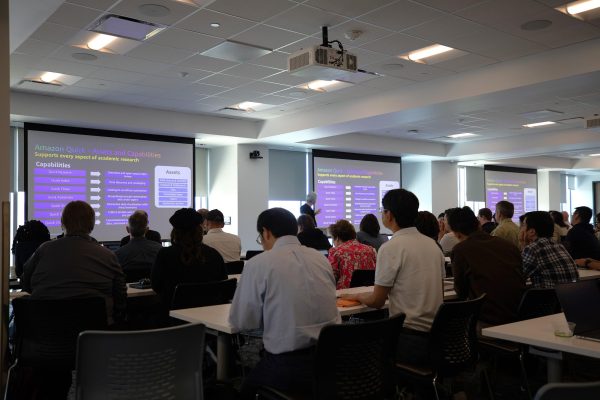
The workshop also explored how artificial intelligence is changing research. AWS Principal Solutions Architect, Dr. Claudiu Farcas, demonstrated Amazon Quick, an AI-powered research assistant that can analyze information and data, create summaries and act as a research assistant.
Farcas said AI tools are only effective with appropriate context and safeguards. “The tools are only as useful as they understand the context in which we offer,” he said. “They need context, metadata, guidance.”
He also cautioned researchers about giving sensitive information to AI platforms without understanding how the data may be used. Farcas said it’s important that researchers work in environments where they have control over their information while benefiting from AI.
Farcas showed all of the assets that Amazon Quick can provide for researchers, including acting as a domain expert, data analyst, research assistant and automation engineer. He said that AI can keep “effective things in one place.”
Training and future applications
Throughout the event, attendees explored tools such as Amazon SageMaker Unified Studio, Amazon Bedrock and platforms designed for data, machine learning, research and computing. Sessions covered topics about cost optimization, financial operations and AI-assisted data management.
The second day had hands-on workshops where participants used cloud-based research tools to gain experience in secure environments. This event also highlighted the increase in research using large datasets and artificial intelligence. Through training and guidance on compliance and security, the two-day workshop showed how to better navigate research.
According to Young, the workshop’s purpose was to enable future research. “At the end of the day, this is about keeping important research moving when the data and responsible climate get more complex,” Young said. “I never want you to say no to some new, exciting research project. I want you to write that proposal with confidence.”