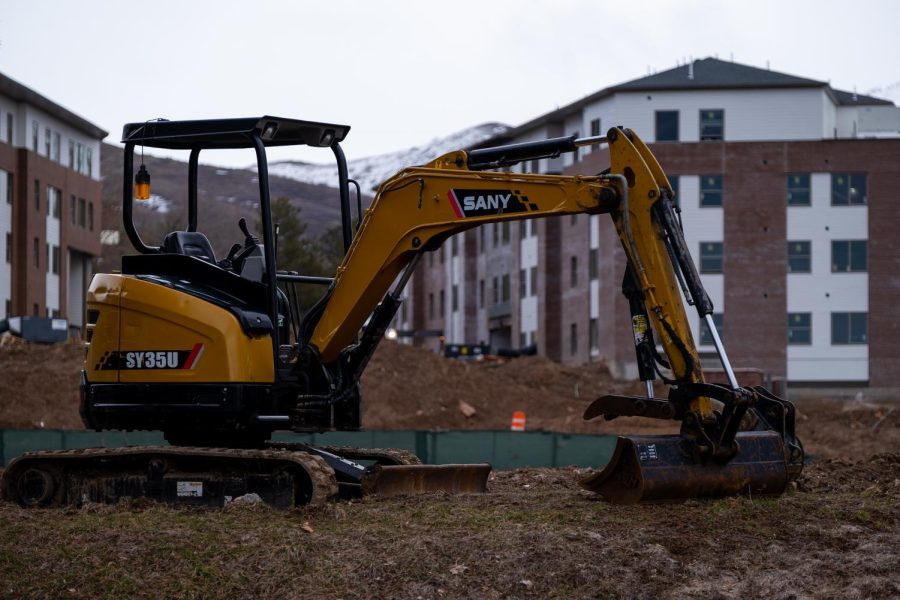
Utah is just under 3000 days away from hosting the 2034 Winter Olympics. The University of Utah’s campus is changing in preparation, including the opening and closing ceremonies and the Athlete’s Village.
On Nov. 24, 2025, the 2034 Utah Olympic Committee hosted an event in the SLC International Airport to celebrate 3000 days away from the Olympics.
Gov. Spencer Cox, President and Executive Chair of the Organizing Committee Fraser Bullock and others announced the official name and logo for the Games. In interviews with The Chronicle, they detailed information on some of the changes in the U’s campus for housing and the ceremonies.
The U and the Olympics
“The University of Utah is one of our very most important partners,” Bullock said. “That’s where the Olympic Village is going to be and the Paralympic village is going to be. That’s where the opening ceremony and the closing ceremony are going to be.”
These changes, including the relocation of Jon M. Huntsman Center and the integration of “college town magic,” are highlighted in University President Taylor Randall’s Physical Development Framework which will “prepare for the 2034 Olympic Games.”
Sports facilities on campus
The Committee plans on using the recently expanded Rice-Eccles Stadium to host the opening and closing ceremonies as they did in 2002.“With the beautiful Rice-Eccles Stadium, to have that as home to the opening and closing ceremony,” Bullock said. “The U has been an exceptional partner every step of the way.”
Jennifer Reed, the senior associate vice president for auxiliary services and operations, said that the stadium won’t change outside of upgrades “that we wouldn’t otherwise do for Utah football or special events, things that we host on campus anyways.”
“Based on previous studies, we don’t necessarily need an expansion of our stadium seating for Utah football,” Reed said, “but we would love to have more premium seating than we have and enhance the guest experience at Rice-Eccles Stadium.”
Reed mentioned fixing other things, like the concourse size in the stadium as “things get really crowded around the concession stands during breaks at Utah football.”
“There are things that we could do to enhance the guest experience that would also enhance the opening and closing ceremonies, and those are some of the things we’re thinking about,” Reed said. “We will likely add some temporary seating to the Rice-Eccles Stadium, potentially some permanent seating, but those decisions have yet to be made.”
“Obviously, with the U we’re so excited to have the stadium for opening and closing ceremonies, as well as the village. Having one central village is so unique in the world, and that’ll be terrific,” President and CEO of the Utah Olympic Legacy Foundation (UOLF) Colin Hilton said.
Athlete housing
Furthermore, the U’s campus will also host the Athletes Village. The Olympics will be “housing athletes in housing that is normally utilized for student housing” Reed said.
Reed also mentioned that the Athletes Village would be in all of the housing “east of Mario Capecchi.” Upper campus will also have “some security perimeter around the Athletes Village and then the stadium,” said Reed.
Athletes from over 100 countries will be housed in this centralized village and will be able to “experience the U,” Bullock said. This centralized model differs from other Games. For example, the plans for the LA 2029 Games have athletes spread out amongst several locations.
Goals for the U
The U has begun to undergo changes in their infrastructure to make way for the upcoming Games. President Randall has set “aspirational goals” for the institution, one of which includes preparing for the 2034 Olympic Games. These goals stem from his Physical Development Framework which also highlight plans for “college town magic.” The plan aims to focus on residency, student life and increased dining, social spaces and recreation. This plan will also take into account the changes needed for the Games.
Reed mentioned that the U will rehouse the students living on campus when the Games come to Utah. “The construction and the housing that’s coming with college town magic can support students,” Reed said. “So, we can transition students to those new beds.” According to Reed, college town magic will add thousands of beds to campus housing, and the timeline for college town magic will also align with the Olympic changes.
One developing change on campus is the relocation of the Jon M. Huntsman Center. In March 2025, the U released their intention to move the arena to make way for the new infrastructural framework. On this relocation, there have been no updates since the announcements. However, the athletic department is on a “comprehensive journey” to identify a new ideal location.
According to Brad Wilson, CEO of Utah 2034, the U has been monumental in the return of the Games. “The University of U is a major partner and critical to the success of the games,” Wilson said. “It’s part of why we were so prepared to get the games back again, is because of the partnership with the University, all the infrastructure that’s being built.”