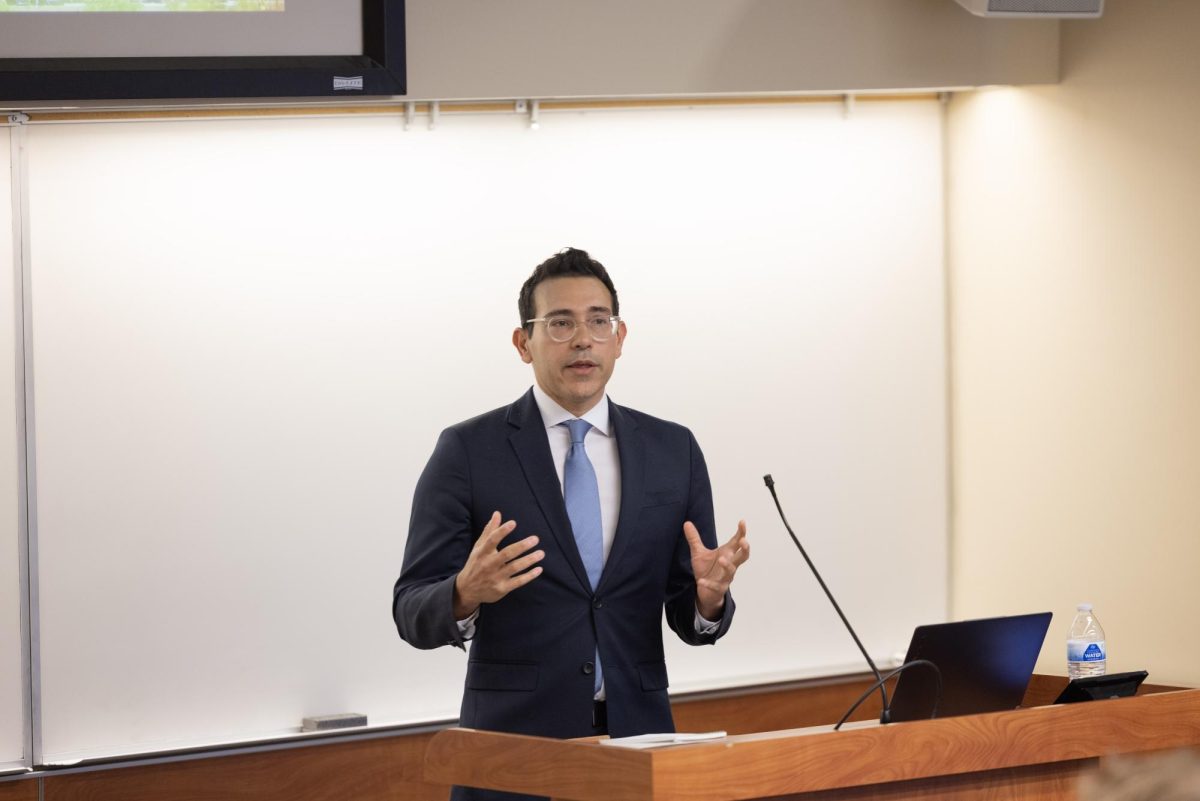
A New York University (NYU) professor gave a lecture at the University of Utah on Feb. 27 about Venezuela’s “past, present and future.”
NYU professor of Latin American history Alejandro Velasco visited the U last Friday for a presentation in the Carolyn Tanner Irish Humanities Building. He spoke on Venezuela’s past, current and future socioeconomic and political position. A mix of over 50 students and faculty attended. “Maduro’s kidnapping and extradition has completely transfigured the realm of political opportunities … available to Venezuela,” Velasco said.
Post-Maduro Venezuela
Former president Nicolás Maduro was captured by American armed forces on Jan. 3, following months of conflict over alleged drug trafficking and oil trading. Velasco criticized the lack of legal process in how the US dealt with traffickers. “The reality is that there’s no legal precedent for the arrest, kidnapping, extraction [and] capture of a foreign leader,” he said.
Despite the Trump administration’s initial control of Venezuela’s government following the attack, the nation’s leadership was passed to Maduro’s vice president, Delcy Rodriguez. Other prominent politicians in Maduro’s administration have remained in power through this transition. They include the President of the National Assembly, Jorge Rodríguez, Minister of Defense Vladimir López and Minister of Interior, Diosdado Cabello.
Velasco said this was no coincidence. He argued that each of these politicians remained in power because of their influence over the economy, police and legislation. Their continued leadership is bringing stability and renewed opportunity to the Venezuelan government, which was in the US’s best interest, he said. “It’s just so difficult for me to believe that the post-Maduro transition could have happened as quickly and seamlessly … without some prior knowledge,” he said.
Velasco later discussed significant legal changes that took place after Maduro’s extradition. Most notably, he said, was the amendment to the Organic Hydrocarbons Law, which opened the country’s oil and gas industry to private participation. He said the Venezuelan government also stopped exporting oil to Cuba, China and India. Embargoes have reportedly eased, allowing specific oil companies to continue selling oil.
Understanding Chavismo
Velasco said that understanding Chavismo, Hugo Chávez’s regime from the early 2000s, is critical to understanding Latin American politics. Velasco argued that Chavismo was never a cohesive political ideology. “We have to think of Chavismo … as a political movement whose hallmark is adaptation over time, rather than ideological movements,” he said.
He said he views Maduro’s government as a continuation of Chavismo, similar to how the new administration is a new stage in the political evolution. Many of the current Venezuelan political actors, including Delcy Rodriguez, started their political careers under Chavez. “I think that the regime still remains in place, but the reality is that much has changed, not only on the surface, but maybe below the surface,” Velasco said.
Velasco said he seeks the mainstream understanding of Chavismo to be more pragmatist than socialist. He said it will improve Venezuela’s economic and political restoration. “It’s going to allow us to see opportunities for reconciliation beyond the polarization that has marked the interpretations of Venezuela in the past,” Velasco said. “My greatest worry is that polarization will mark the future of Venezuela.”