This article originally appeared in the Resolutions print issue, in stands February 2026. It has not been updated and some information may be out of date.
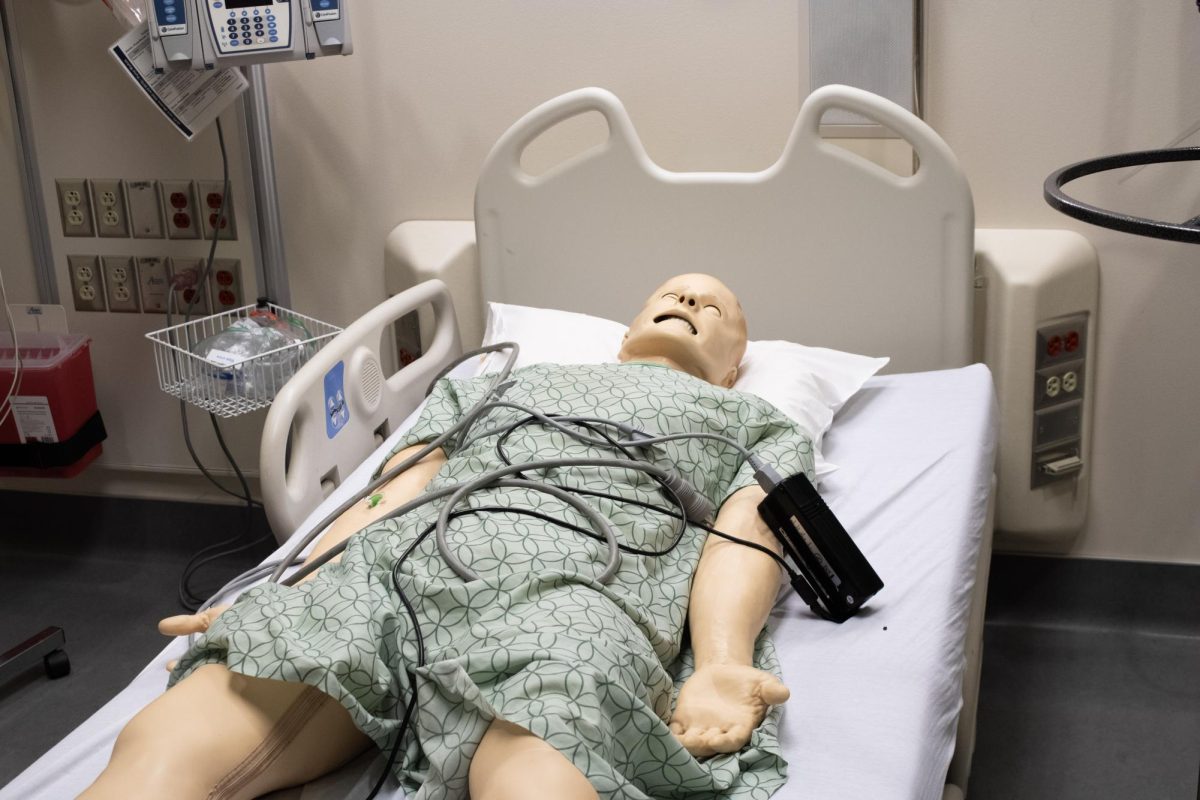
The University of Utah’s medical research funding reached $531 million in 2025, accounting for the majority of the university’s $781.9 million in total research support. A portion of this investment supports the U’s simulation labs, where students in the College of Nursing and other medical programs use a combination of high-tech mannequins and professional actors to prepare for clinical practice.
Kira Logue, a student in the College of Nursing, said she feels more prepared to enter the workforce than people at other universities. “They prepare the nurses really well, compared to other colleges … they’re more ready,” Logue said.
Logue credits much of her preparation to the simulation center at the University, where students train for real-world scenarios. “Having a good sim lab that’s realistic gives you that chance to be independent. It allows you to see what you can do on your own without needing to follow [someone] around,” Logue said.
The program
The sim labs at the U aim to prepare students for a career in medicine by giving them practice in real environments. Bobby Cody, the SP coordinator, said sim labs are meant to build confidence. “It’s the confidence of being able to walk into a patient’s room and be ready for whatever you encounter,” he said. “I feel like the more that they rehearse and go through these simulations, the less anxiety and stress they think about the moment before.”
The center combines both high-end mannequins and local professional actors to achieve realism. “I really like how realistic it is,” Logue said. “I feel like I’m super prepared when I go into a hospital setting.”
The program covers everything from “air med to midwifery,” Cody said. He added that using professional actors elevates the U’s program by creating a more immersive experience for students — a feature he frequently discusses at global simulation conferences. “I’ve spoken to those that usually use either students or other educators to play the patient roles. The resounding answer that I’ve gotten … [using students and educators] just isn’t quite as immersive as if you had an actor playing that particular role,” Cody said.
Students go to the sim labs several times a semester to get hands-on experience. There are two levels to the program: basic and advanced. The basic simulations can be practicing injections on a prosthetic arm or learning how to treat a patient postoperatively. The advanced simulations can include students having to help grieving patients as they lose loved ones.
Paul Anthony Sonnier Jr., one of the actors in the program, said the grieving scene was his favorite because of the human connection he experiences with the students. “Seeing these nurses be so caring, empathetic and wanting to help … I think it’s just such a beautiful scene,” Sonnier said. “It’s human nature … how they can just be there and give that love and care to a stranger.”
Cody notes that veteran medical personnel at the hospital also use the sim labs. Additionally, he says there is more international recognition of the program. “It’s definitely expanding more on a global level,” Cody said.

Impact
The Executive Director of the Simulation & Experiential Learning program, Ann Butt, said the program is “active learning at its finest.” Butt emphasized she wanted it to be a safe space for students to learn. “This is an opportunity to put together some of the things you’ve learned. Some of the individual skills that you’ve learned for taking care of a patient,” she said.
Cody said he believed the simulation labs gave students an advantage when trying to find jobs after graduation. “Day one, a lot of our people hit the ground running,” he said. “So, as an employer, [having sim lab experience] would be huge.”
Logue said the simulations gave her the confidence to succeed. “Having the opportunity to be on my own in the sim really helped me build confidence,” she said. “It made me realize I can actually do this.”
Cody, who has experienced “very bad situations in medicine,” said he is glad empathy remains a primary focus. “To learn how to communicate and interact with humans who aren’t just walking down the street but are in extreme, excruciating pain, who are terrified, who are fearful of the unknown — it takes a very special hand to help people do that,” he said. “I feel like what we’ve been doing in simulation gives them not only the tools to provide that empathy, but the confidence to exude that aura of … you’re in good hands.”
When asked if he would trust the nurses coming out of the U, Sonnier said, “Definitely.”