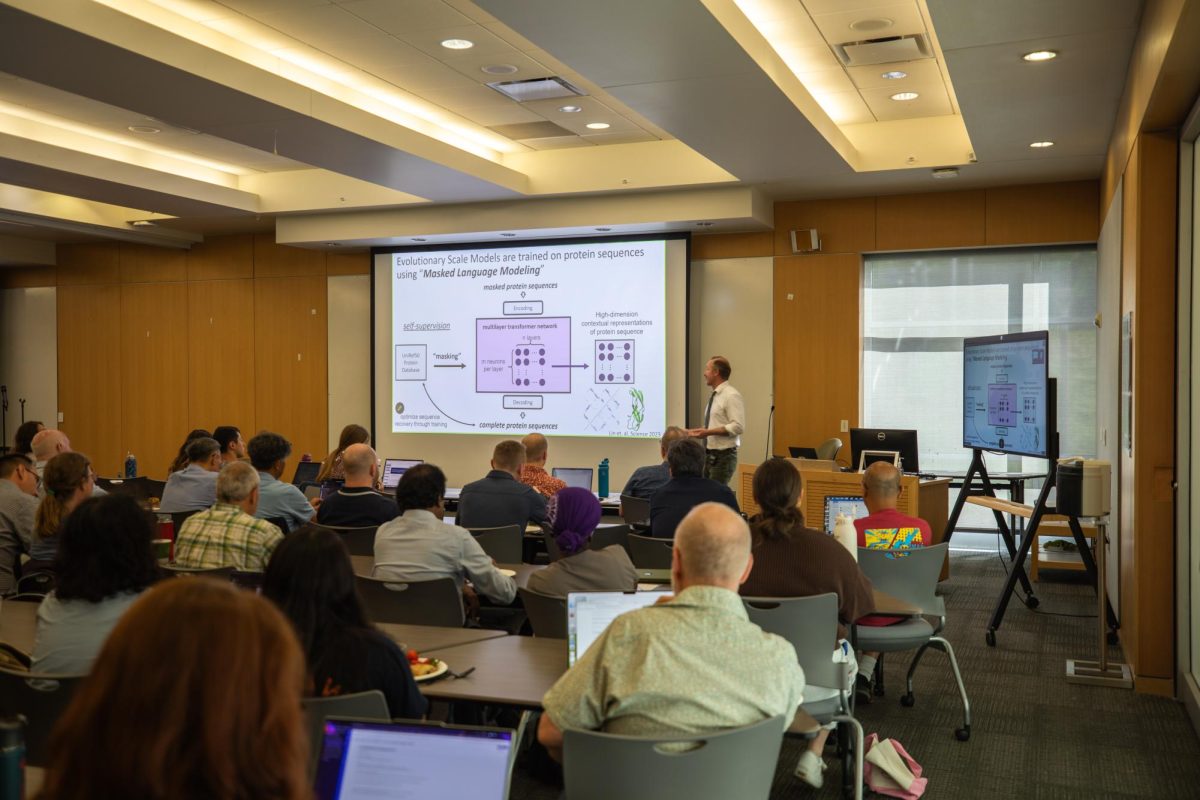
Speakers from the University of Utah and beyond gathered at the U on June 25 to feature in the AI in Protein Structure, Function and Discovery Symposium to showcase recent developments in science and technology.
Held at the Eccles Health Sciences Education building, the symposium highlighted recent breakthroughs in artificial intelligence that have enabled the accurate prediction of protein structures, the identification of previously unknown molecular interactions and the design of proteins and small molecules for potential medical applications.
Why AI matters biologically
Deep learning models, including Google DeepMind’s AlphaFold and the University of Washington’s RosettaFold, were pioneers in developing this technological leap. By utilizing databases of known biological structures, these AI structures are trained to predict the 3D shapes of proteins in a matter of minutes. Modern AI goes beyond mapping single proteins, it can map complex interactions.
Amanda Karchner, an undergraduate researcher working in the Department of Nutrition and Integrative Physiology, presented research during the poster session demonstrating how AI can help identify protein interactions linked to diseases such as diabetes, cancer and metabolic disorders.
Using the AI model Boltz-2 through the U’s Center for High Performance Computing (CHPC), Karchner and her peers screened potential protein interactions far more efficiently than traditional laboratory methods. “When we talk about protein-metabolite interactions, those are so important for all kinds of cellular regulation,” Karchner said during her presentation. “When your cellular regulation is messed up, that’s cancer or metabolic disease.”
Rather than replacing laboratory experiments, Karchner told The Chronicle that the AI serves as a hypothesis-generating tool that helps researchers identify the most promising protein interactions to test experimentally.
From years to minutes
For 50 years, biology has faced the protein folding problem. A protein’s function in the human body is determined by its complex, twisted 3D shape, yet it takes scientists months or even years to figure that shape out from a simple string of amino acids.
During a poster session, research from students and scientists discussed how these AI tools are being applied to ongoing modernization.
The university’s high-performance computing center is making AI research possible. These AI-based tools have made protein structure prediction reliable enough for many laboratories to incorporate into their work.
CHPC computational scientist Martin Cuma, PhD, said that computational methods existed, although they were not accurate enough for many laboratory researchers. “We’re basically helping users enable their research on our systems,” Cuma said during an interview with The Chronicle.
According to Cuma, the CHPC provides researchers with access to supercomputers, large-scale data storage, specialized software and technical support needed to run AI models that exceed the standard computer capacity. “Every researcher who’s doing some computation on their laptop and the computation is too big for their laptop, they need to go onto a supercomputer,” Cuma said.
Instead of spending months or years and incredibly expensive procedures determining a protein’s structure through traditional methods, researchers can now generate predictions with a higher rate of accuracy.
The traditional cost
Doing this study via traditional laboratory experiments is expensive and slow. Before AI, figuring out a single protein structure was a difficult process. Costs depend heavily on whether researchers are analyzing a simple protein or a complex one.
Mapping a brand new protein structure from scratch can cost anywhere between $66,000 to $138,000. Structural biology labs estimate that over 60% of the total budget spent on traditional structure determination goes towards failed attempts.
The revolution in testing with AI modeling represents one of the most radical cost reductions in modern scientific history.
While an experimental lab requires heavy labor and thousands of dollars, with AI, if a prediction fails or has low accuracy, the cost is low.
Symposium speakers explained that by narrowing potential protein interactions to the most promising results, AI allows scientists to spend time testing discoveries that could improve medical understanding.
As AI continues to evolve, the technology and software are helping University of Utah researchers accelerate discovery while reducing the time and cost required to study complex biological questions.