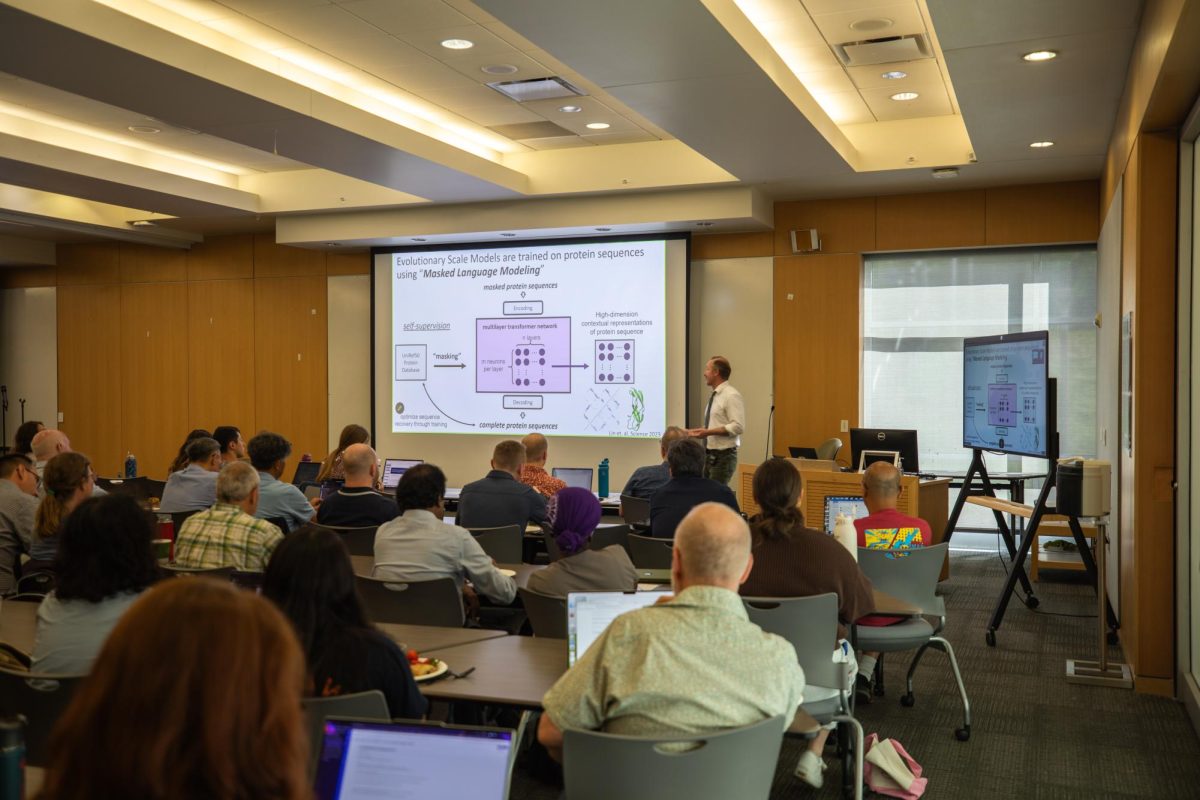
The College of Humanities has faced over $3.4 million in defunding, stated Dean Wanda Pillow at a student Q&A event held on March 3.
Pillow discussed the funding losses alongside recent advising changes and the college’s goals around artificial intelligence during the event, held in the Language and Communications Building.
Revenue plans
Pillow discussed budget cuts and the goals of revenue in the future. Recently, a number of programs relating to the humanities and sciences have been cut due to HB 265.
A student in attendance raised a question about graduate programs at the University of Utah and their acceptance rates. Pillow responded by discussing the relationship between undergraduate and graduate programs within the humanities. “It is such a complex arrangement for any college: your relationship between your undergraduate delivery and undergraduate education is really linked in so many ways,” Pillow stated, “When we make a decision in one area, it impacts another area.”
Pillow then said that multiple changes in structuring have been impacting graduate students, ranging from defunding to budget cuts and limitations. She said that one of her goals as dean is to help increase revenue in order to invest in program funding for prospective students. “We’ve had over $3.4 million of defunding. That may sound small compared to other units, but we’re a smaller college … we don’t have the kind of non-state funds to allow our college to be nimble and responsive,” Pillow said in response to how Humanities is addressing the lowering acceptance rates of graduate programs at the U.
Additionally, one of Pillow’s goals to increase funding is to become more involved with artificial intelligence initiatives at the U. Pillow said that the College of Humanities needs to be a central partner with AI. She said the U is behind when it comes to AI implementation within various programs.
Along with combining the college with AI, Pillow said that she hopes the College of Humanities can build relationships with other colleges beyond LAS that have used AI to their benefit. “We have really good other thought partners outside of LAS that I’m working with on that, and I’m hopeful. I want Humanities to be central. You can’t have technology without talking about humans,” Pillow said.
Advising changes
The Q-and-A also discussed recent advising changes implemented at the U. The college recently changed the advising structure to stabilize the number of students assigned to each advisor.
The college introduced the changes in two phases as part of a plan that began in fall 2024. The first was to reorganize leadership within the Colleges of Humanities, Science and Social and Behavioral Science, as well as the School for Cultural and Social Transformation. This combination created the College of Liberal Arts and Sciences (LAS), and led to shared advising across the board for all departments.
Karen Marsh, director of Student Success for LAS, spoke to the challenges of the transition. “This is really going to help us elevate the advising all across campus,” Marsh said. “The transition right is a real challenge for the advisors, for some of the students involved. But I think the goal is a really good one in the end.”
In spring 2026, LAS introduced the second phase of advising changes, redistributing caseload assignments among advisors. These changes were made to improve student experience on campus, as well as get closer to the U’s Impact 2030 strategy. Impact 2030 is the U’s long-term strategic plan that aims to expand enrollment, increase research funding and improve graduation and career outcomes for students before 2030.
Pillow commented on the structural changes within LAS advising. “I think this model will be very effective. I think that it reaches more students,” she said. “It’s really on our faculty now, and departments to begin to understand how advising works.”