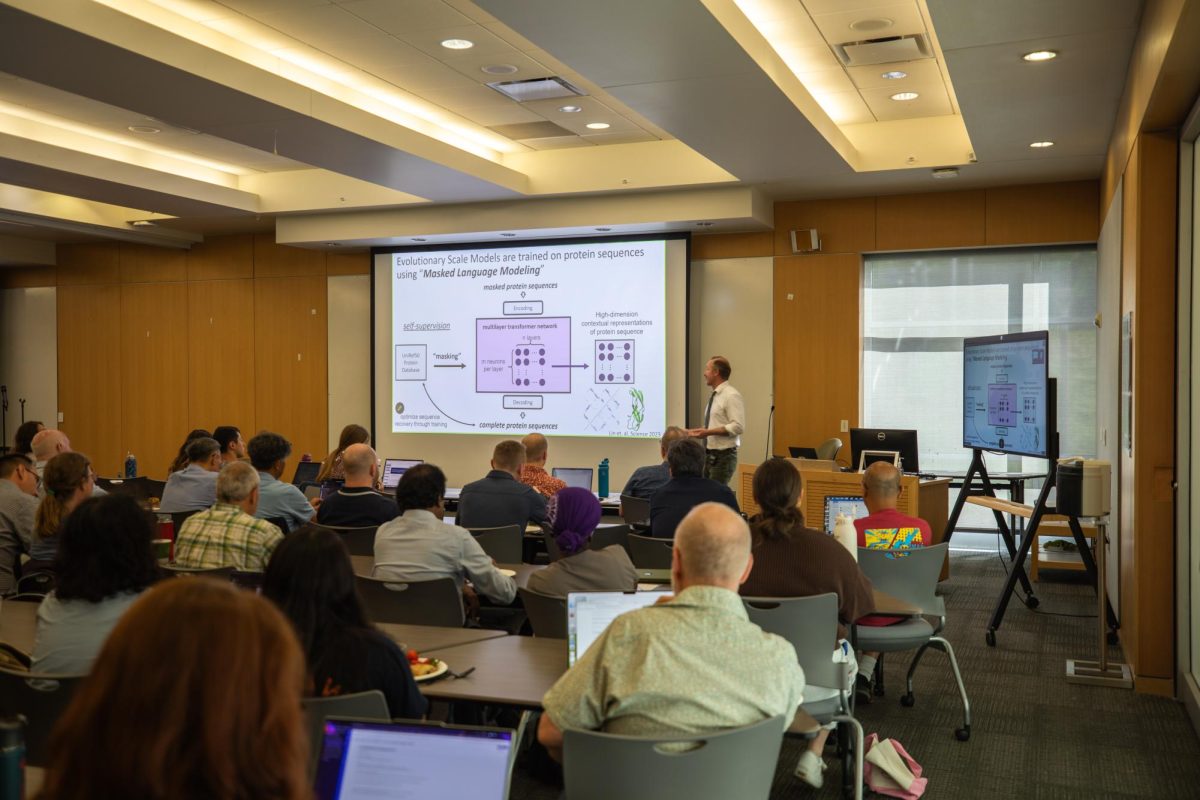
Scholars from across the country gathered Friday, March 20 at the Language and Communication Building (LNCO) to examine how the world shapes, communicates and remembers protest movements.
The “Media, Protest and Resistance” symposium brought together faculty and students from multiple universities for a day of research presentations. Two faculty panels and a student panel examined the roles of media, power and public memory in resistance movements, while encouraging discussion about the long-term impact of activism.
Faculty panel 1: borders, media and activism
The first faculty panel featured Dr. Raisa Alvarado, Dr. Joshua Guitar and Dr. Raquel Moreira. The speakers focused on how protest movements circulate across borders, how media frames activism and how global and local struggles connect. Consequently, each speaker demonstrated how communication systems shape what the public sees and what gets overlooked.
Additionally, the panel highlighted the importance of analyzing both international and local contexts to fully understand activist strategies. Alvarado, an assistant professor at California State University, San Bernardino, emphasized how people negotiate identity and belonging within these movements, especially in digital spaces.
“I’m really interested in the ways that we perform culture,” Alvarado said. “More specifically, I’m interested in who gets to decide who belongs and who doesn’t.”
Through her research, Alvarado presents how marginalized communities challenge rigid definitions of identity and push back against cultural gatekeeping. In doing so, she connects questions of representation to broader systems of power and visibility.
Faculty panel 2: identity, visibility and structural inequality
The second faculty panel included Dr. Danielle K. Brown, Dr. Logan Gomez and Dr. Arthur Soto-Vásquez. Their presentations explored identity, visibility, and structural inequality in protest movements.
Gomez, a University of Utah professor, highlighted the “Say Her Name” movement. She argued that the phrase goes beyond a hashtag and actively challenges the systemic erasure of Black women in discussions of police violence. In particular, Gomez emphasized the social and political significance of naming victims.
“It’s not just about how we should know their names, but why we don’t know them in the first place,” Gomez said.
She described the movement as a form of “world-making” that creates space for grief, resistance, and collective care. “Whether you get justice or not,” she added, “this will always be what we do.”
Brown and Soto-Vásquez expanded the discussion by examining how race, media and public narratives shape the public’s understanding of protest movements. Together, they emphasized that visibility does not always lead to justice, and that representation often carries limits.
Student panel: applying theory to practice
During the graduate student panel, presenters applied these broader ideas to specific case studies. For instance, Collin Bright analyzed Raye’s performance at the 2025 Grammy Awards and questioned how scholars approach race in popular culture. He argued that focusing solely on systems like anti-Blackness can flatten individual experience.
“At that point, the artist is no longer important,” Bright said. “They become a cog within the wheel.”
Similarly, Ellie Estrada focused on transgender studies, calling for a shift in how research represents trans people of color. They criticized academic approaches that center on harm and reduce lives to data points. “We are not just a statistic, but rather a possibility,” Estrada said.
Emma Murdock examined the medical industry and argued that “rhetorics of innovation” often prioritize profit over patient safety. Drawing on the documentary “The Bleeding Edge,” she showed how companies promote new technologies while downplaying risk, often leading to unforeseen harm.
“Innovation wants us to live for the future,” Murdock said. “but it erases the lived experience of individuals.”
Casey Zukosky connected the discussion to Salt Lake City. Their research focused on the Fleet Block murals, which activists created during the 2020 protests against police violence. Developers demolished the murals in 2025 during redevelopment. Nevertheless, the site continues to influence public memory.
“To dwell only on absence is to miss what still remains,” Zukosky said. They argued that the site continues to shape public memory through a “living narrative,” carried forward through community engagement, storytelling, and activism.
Key takeaways: resistance across time
Across all panels, participants shared a similar theme. Protest movements do not exist as single moments. Instead, they unfold over time, shift across media and depend on how people remember and represent them.
Speakers challenged the audience to look beyond simplified narratives and consider how resistance operates in everyday life. Rather than offering easy answers, the symposium posed a deeper question of what it takes for resistance to last. Ultimately, according to the speakers, understanding resistance requires examining both visible actions and everyday practices of care and advocacy.
“For most people, it’s the retelling of protests that really matters,” Brown said. “Community is needed for people to still believe in our ability to have a democracy — and to fight for it.”