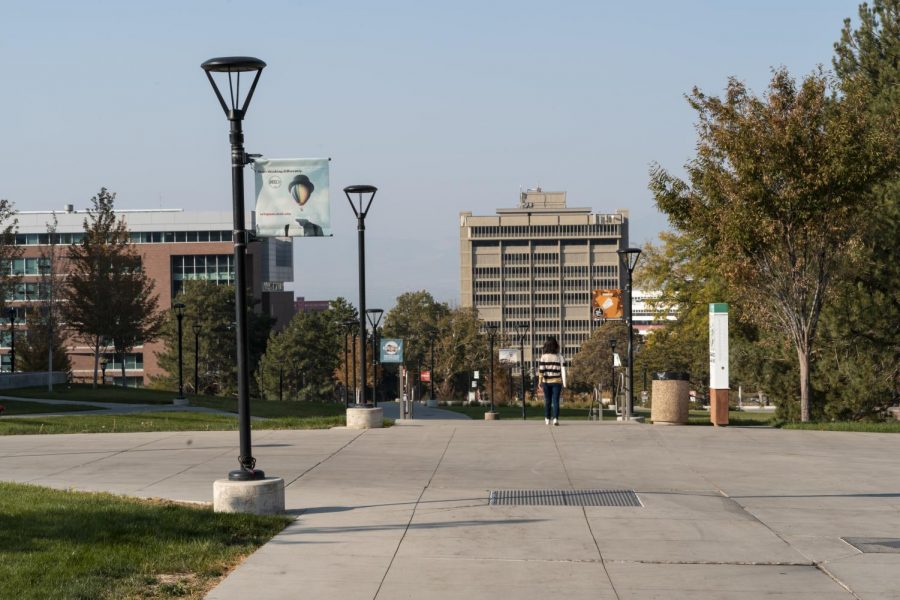
On Thursday, March 19, the University of Utah hosted its fourth annual Utah Campus Safety Summit, where law enforcement, professionals and students gathered to learn from speakers with experience in handling emergency situations. The summit focused on one encompassing theme: preventing and preparing for active threats on campus.
Hosted by the U’s Department of Public Safety, the summit took place in the Cleone Peterson Eccles Alumni House. This year, tickets were completely sold out. U Police Chief Safety Officer Keith Squires started the day with an opening speech. He told the audience that every year, the Department of Public Safety modifies the content to fit current security concerns on campus.
This year, the summit zeroed in on active aggression. “People will often ask, what issue keeps me up at night? Well, this is it. Having an active aggressor on campus is one of those incidents we hear about all too often in the news, but hope we never have to deal with it on our campus.” Squires said.“That isn’t enough. We must have a plan of action.”
Learning from a survivor
Kristina Anderson Froling opened the summit with the first keynote presentation of the day. A survivor of the 2007 Virginia Tech mass shooting, Froling founded the Koshka Foundation for Safe Schools, a nonprofit that focuses on healing communities in the aftermath of mass shootings.
Froling began her presentation with a retelling of her experience at the forefront of a nationwide tragedy. 19 at the time, she watched the perpetrator–who she intentionally did not name — killed 32 students and faculty and injured dozens of others. Sustaining three bullet wounds, Froling spoke about how her physical and mental recovery progressed almost twenty years after the fact.
“This healing process is not a linear process. I have met many people that did not go back to the place where they were involved in a shooting until years or decades later,” Froling said. “That is when they reclaim that journey, when they walk into the choir room they were trapped in for three hours.”
Immediately after the shooting, which she described as “catalyst in campus and community safety,” Virginia Tech invested in a multimillion-dollar renovation to expand the building’s hallways and add exit routes. The university added internal locks to every door and installed whiteboards to cover bullet holes.
In an interview with The Chronicle, Froling advised students not to believe everything in the news, since often situations can be blown out of proportion when an insufficient amount of information exists. While she sympathizes with the fear of the unknown, she said, civilians must be cognizant of the police process.
“Police are between a rock and a hard place,” she said. “They either send out the wrong information but it’s really quick or they send out the right information but it takes too long. They can’t win.”
Lessons through experience
Later, Froling said that lessons about mass violence can be learned from responses to past events. “Sometimes the research and the best lessons learned have been around for a very long time,” Froling said, referencing the 1999 Columbine High School shooting.
Closing her presentation, Froling advised on how to navigate being a member of the “club that no one wants to belong to,” or in other terms, surviving mass violence. Life is unpredictable and individuals must be grateful for their relationships, she said. “Learn how to appreciate traffic,” Froling said. “Living in a big urban city, it’s a very painful, terrible experience, but it is a gift of time.”
Later in the summit, Assistant Sheriff of the Las Vegas Metropolitan Police Department Bryan Peterson reviewed how his team responded to the deadliest school shooting in Nevada history. In December of 2023, a perpetrator dressed as a professor, walked into a University of Nevada, Las Vegas building and shot four people, killing three.
His case review focused on the law enforcement aspect of the shooting. Using bodycam footage, maps, images and witness reports, Peterson took note of failures in the department’s response. While he pointed out some successes, he also listed several errors law enforcement had to learn from, including: overlapping radio channels, miscommunication, plainclothes officers and overconvergence leading to backlogs, echo calls and duplication of efforts.
At the end of his presentation, Peterson added that strong leadership and rule-following can make-or-break a dangerous situation. “You are only as successful as good as your leadership is, and your leadership needs to balance the emotional response,” Peterson said. “We’re only as good as the processes we enforce.”
Standard police protocol
In a breakout session, Sergeant Jason Miller of the University of Utah Police Department (UUPD) and Clinical Social Worker Josh Whatcott presented on what civilians should expect from police’s initial response to an active aggressor event.
The presentation examined stress response and behavior during crisis situations. Additionally, with a goal of “bridging understanding between civilians and law enforcement,” Miller and Whatcott covered the rationale between certain police responses that civilians are often not privy to.
Firstly, Miller said the first priority is always to stop the aggressor. If there is a stimulus, most commonly a weapon, officers cannot administer medical assistance until the threat is cleared. Additionally, police evaluate every person they encounter, since perpetrators do not fit one description. Miller advised civilians to verify police identification before opening barricades, and in the case of an active shooter, to run outside the building with open hands.
University changes
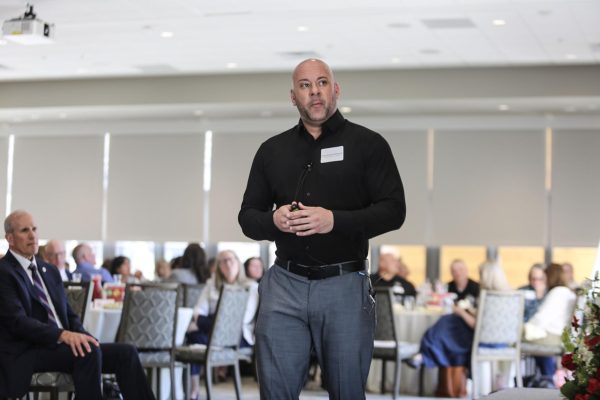
Stuart Moffatt, Director of Emergency Management for UUPD, talked about critical response, safety alerts, warnings and protective actions that the department is working to implement on campus. Standard Response Protocol (SRP) and Warning Lexicon — two programs that control emergency responses — are in the process of merging together. The project would change higher education mass notification, transforming it into a clearer system of action. “This is also a moment of continuous improvement and realignment in a real incident, clarity, timing and actions that the public and the responders take need to work together,” Moffat said. “When they do, we put ourselves in a better position to protect our campus communities.”
Moffatt stressed the importance of careful language in active aggressor alerts in order to keep control and ensure the campus community’s safety. “It’s not the value of the protective action. It’s not even the value of just having any clear action,” Moffatt said, “What changes is the decision environment on a college campus. We’re dealing with self-directed adults, open and mixed-use spaces, spaces and less centralized supervision that creates more uncertainty about whether a message applies even at all.”
The framework of SRP acts as a template to help make sense of protective action on campus. It leaves room to adapt the message alerts for the context of a situation so people can stay informed about the best course of action.
More plans for prevention
In cases of active threats on campus, the UUPD is working to tailor the dispatch process so a message will be released immediately. They also plan to change the current campus alert system, which requires people to opt in to receiving messages. Now, everyone must actively opt out of notifications, a switch that would increase the likelihood of an individual receiving emergency notifications.
One of the U’s Department of Public Safety’s primary goals is to stop violent crimes before they happen. To achieve that, the U is formulating training for faculty and students on how to handle an active threat.
Additionally, the university offers resources to those who show warning signs of violence, as well as those who are victims of violence themselves. “We must have a shared culture of safety awareness, a commitment to information-sharing and collaboration within our campus and our institutional partners,” Squires said. “Preventing and responding to an active aggressor event is everyone’s responsibility.”
Resources
Active Threat Education or Reporting:
- University of Utah Police: 585-COPS or 911
Mental Health Support:
- Free counselors are available 24/7 at SafeUT.org
- Center for Campus Wellness
- Blomquist Hale: 801-262-9616