Salt Lake City’s spinoff of the hit show “Real Housewives” has become a hit phenomenon both in and outside Utah. From watch parties to academic analysis, the show has become a ripe subject for cultural review.
On April 10, the University of Utah Tanner Humanities Center hosted “Receipts, Proof, Timeline: How we watch The Real Housewives of Salt Lake City,” at the Cleone Peterson Eccles Alumni House. Various panelists, which included a mix of scholars and fans, participated in the event.
The symposium broadly focused on the show’s cultural impact, discussing the role of relationships within the show, Utah’s specific place in broader culture as well as analysis of the show in an academic context.
Event background
Tanner Humanities director Scott Black said the initial idea for the event originally started from a joke from one of his colleagues. “I apparently cannot take a joke, because I thought, ‘That’s a great idea,’” he said in an interview with The Chronicle.
He also emphasized the inclusion of entertainment viewed as “low-brow” in the humanities field. “We have a really broad view of the humanities. We think it should include high brow to low brow. We think pop culture can tell us a lot about our communities,” he said.
He said of “Real Housewives,” “There’s nothing more directly popular but also influential in our community.” Additionally, he pointed to the Salt Lake spinoff of Real Housewives and other Utah reality television programs as “one of the biggest things happening in Salt Lake City.”
“That’s how the rest of the country and the rest of the world thinks about us,” he added.
Yale scholar Julia Soule echoed Black’s emphasis on including media labeled as “low-brow.” “I don’t really like low brow, high brow culture. I think everything is up for grabs,” she said.
Soule said she was initially drawn to the event as an avid watcher, but discovered the show provided “a more accessible and grounded way for me to talk about morality through a spectacle of conflict.”
Emcee and FOX13 anchor Ben Winslow pointed to this so-called “spectacle” as an enticing aspect of the show. “I’m always fascinated by the line of entertainment and reality,” Winslow said. “It’s an insight into a world that you may not necessarily be a part of.”
Winslow added that Salt Lake City’s “Real Housewives” being studied academically “speaks to how it’s transcended.”
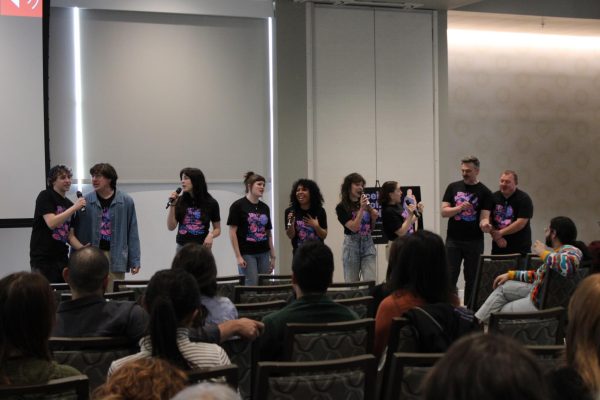
Religion, surveillance and communication on reality TV
The event began with closer analyses of relationships between the cast as well as a look at the show’s broader cultural impact.
Jordan Rullo, a couple’s therapist and U adjunct professor analyzed the Housewives’ communication style in a morning panel. She identified five specific negative communication styles the cast members use, while playing viral clips from the show as examples.
“With the housewives, the negative communication dynamics are rampant,” she said. “It was so difficult to find clips of healthy communication dynamics in the show.”
The most common form of negative communication, she said, was contempt. According to Rullo, contempt is “when you talk to someone as if you are better than them, you look down on them, you mock them, you call them names.”
She said that as she was preparing the presentation, contempt was “hands-down the most common communication style used among the housewives.”
Rullo mentioned editing as a potential cause for contempt being the most common communication style featured in the show, as well as pointing to so-called “drama” as common within the show as a whole. “You don’t get to see in the housewives, probably because of the editing, how things get repaired or how they work through things. We just get to see the drama,” she said.
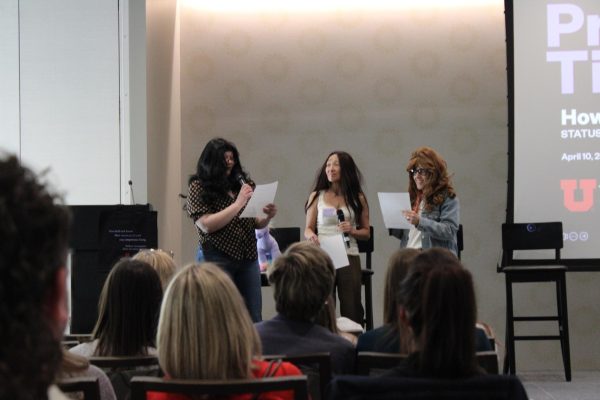
“Real Housewives” as a cultural statement
Westminster junior and panelist Giovanna Grant analyzed the show both as a fan and cultural commentator. She thinks a “big part of what makes the show so compelling is the dynamic between modern Utahns and media spectacle.”
Grant said the cultural issues depicted in the show mirror some Utahns’ real-life experiences. “On one hand, you have real people living in Salt Lake, navigating their relationships, their communities, and in many cases, their relationship to the church,” but that “on the other hand, we see these same cases being played out on TV, but being shaped by the expectations of reality TV.”
“The show isn’t just documenting modern Utah, it’s redefining it,” she added.
Longtime viewer Elizabeth Leach said that as a fan sharing her opinions of reality TV, she is doing “what human beings have been doing around fires, in town squares and in church pews for thousands of years.” Her initial realization fell “somewhere between my third opinion and my second glass of wine. I thought, ‘This is philosophy, this is ethics.’”
“We are sorting out who is good, who is right, and what we owe each other,” she said.