

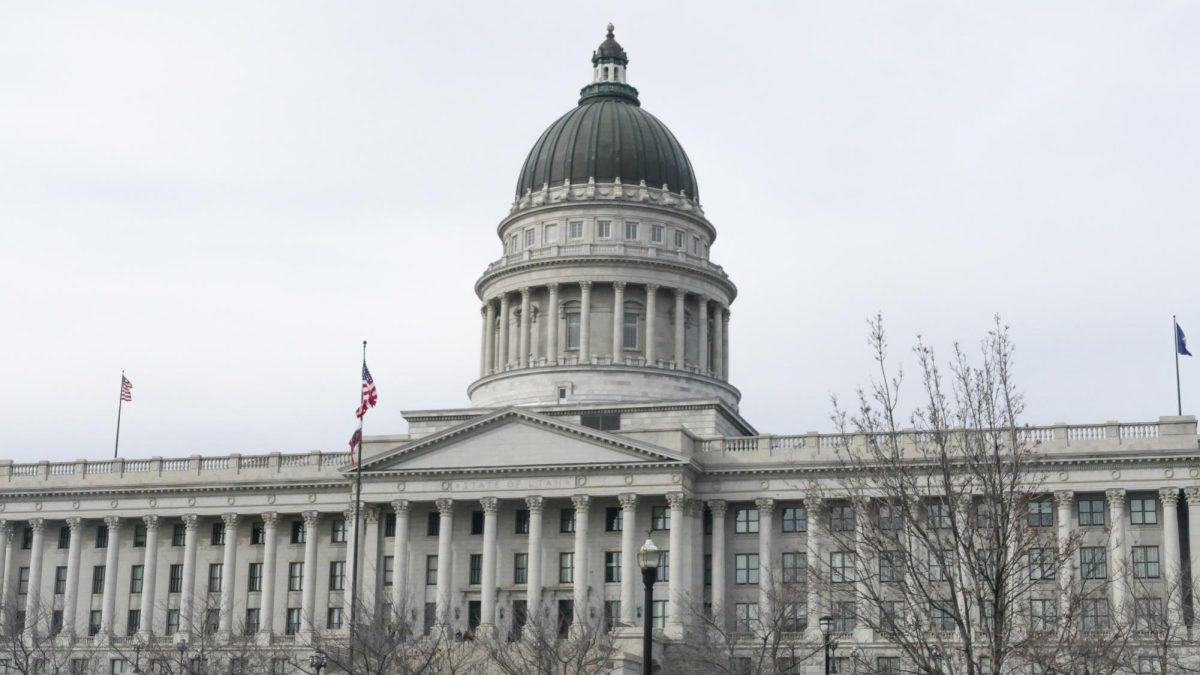
The University of Utah’s academic partnership with Ariel University, formalized through a memorandum of understanding (MOU) signed in May, may violate Utah state law requiring “institutional neutrality.” A petition organized by the U’s chapter of Faculty for Justice in Palestine (FJP) alleges the university violated HB261, a law that bans universities from taking a stance on controversial political issues.
Ariel U is an Israeli university located in occupied West Bank territory, in a settlement considered illegal under international law. Following backlash from the U community, including more than 850 signatures on another petition, university administration changed its MOU process. However, the partnership with Ariel University was unaffected by these changes.
Utah state law
Utah HB261, signed by Gov. Spencer Cox last year, requires universities to maintain institutional neutrality on political topics, which means “an institution of higher education does not take positions on political, social, or cultural controversies, public debates or flashpoint moments,” according to the Utah System of Higher Education (USHE). “The referral to Ariel as being in Israel is what makes the document illegal under Utah state law,” said Marshall Steinbaum, an economics professor at the U. Steinbaum is a member of the U’s chapter of Faculty for Justice in Palestine, the group who organized the petition.
The MOU agreement says Ariel University is located in “Ariel, Israel.” Ariel is an illegal settlement according to the United Nations and Article 49 of the fourth Geneva Convention. “The Utah state law requires the institution not to take a stand on any matter of public controversy, and that is clearly a matter of public controversy,” Steinbaum said.
Ruhan Nagra, a law professor at the U and former clinical instructor at Stanford Law School’s Human Rights Clinic, said the MOU violates USHE’s requirement of institutional neutrality. “The MOU violates the USHE institutional neutrality directive because, by signing this MOU, which asserts that Ariel University is in Israel rather than in occupied Palestinian territory, the University of Utah has endorsed Israel’s attempted annexation of the West Bank, whether or not the U intended to do so,” she said.
Nagra also discussed ethical questions raised by the MOU. “Israel’s attempted annexation of the West Bank is, of course, illegal under international law,” she said. “By signing this MOU, the U is endorsing grave violations of international law.” Before joining the U’s law school, Nagra served as a senior clinical supervisor at the University Network for Human Rights, which she co-founded in 2018.
Federal law
Steinbaum alleged the U’s academic partnership violates federal law, including the Civil Rights Act, barring discrimination. Title VI of the Civil Rights Act “prohibits discrimination on the basis of race, color and national origin in programs and activities receiving federal financial assistance,” according to the U.S. Department of Justice.
“Plenty of people who are either Muslim or Palestinian or both, who are University of Utah community members would not be able to participate in that program,” Steinbaum said. “That makes the MOU and anything coming out of it illegal under federal law as well.” Steinbaum also said how the hiring of a liaison, which is included in the MOU, would exclude Muslim and Palestinian applicants. “The entire state of Israel, in particular in the settlements, is an apartheid regime,” Steinbaum said. “Apartheid is illegal for U.S. universities.”
Federal law does not specifically bar institutions from partnering with foreign universities based on human rights records of the territory they reside in. However, partnerships that result in discriminatory treatment of students or applicants within the U.S. could trigger legal questions.
Changes to MOU process
Following backlash, the U increased its review process for future MOU agreements to include additional oversight from more reviewers within the university. “As a direct result of the controversy that happened, we created this [new] MOU process,” Dr. Randy McCrillis, senior international officer at the U, said.
Today, the U remains partnered with Ariel U through the MOU. “The MOU is in place, so the next review cycle would be five years from now … but there’s no timeline in appointing someone,” McCrillis said. The U has not appointed a liaison for the partnership, which the MOU agreement specifically includes. “Knowing what was happening within Israel, with Israel and Gaza and everything going on there, we decided that we would wait to appoint someone,” he said.
McCrillis discussed the U’s future plans for the partnership with Ariel U. “The university is trying to explore options around how we want to engage with Ariel University,” McCrillis said. “I think at this point in time, we’re in a holding pattern until we understand what we want to do.” When asked what options the U is currently considering with Ariel U, McCrillis said, “I couldn’t tell you.” McCrillis said he doesn’t “think this is a priority for the institution,” referencing different academic partnerships that the U is choosing to prioritize at this time.
U’s legal response
In a June 2025 press release, the U denied allegations that the MOU violated Utah law. “Other campus community members have raised questions and concerns about the MOU serving as a statement of support for Israel in its war in Gaza, or a divergence from state law which requires institutional neutrality. Neither is true,” the U said in the release.
The release also said that “discussions of the MOU began in the fall of 2023 before Israel launched its major offensive in Gaza.” The academic partnership agreement was signed on May 19, 2025.
When asked if there had been a discussion of legality in the administration regarding the MOU, the U’s official spokesperson Heather King said the topic is “subject to attorney-client privilege.” King also addressed why the MOU says Ariel is in Israel. “It is standard for each party to provide its own address information,” she said.
Institutional neutrality panel
On Nov. 20, the U’s law school hosted the 40th Annual Jefferson B. Fordham Debate, where attorney panelists discussed institutional neutrality. Both panelists said the U’s academic partnership with Ariel U is non-neutral.
Jameel Jaffer, a panelist and law professor at Columbia University, criticized institutional neutrality as a concept. “A university has to decide, are we going to have a partnership with Ariel University or not? That is not a neutral decision,” he said during the debate. Jaffer is the inaugural executive director of the Knight First Amendment Institute at Columbia University and a professor of law and journalism. He formerly served as Deputy Legal Director at the American Civil Liberties Union.
Nadine Strossen, who spoke in favor of institutional neutrality, is a professor at New York Law School and senior fellow at The Foundation for Individual Rights and Expression (FIRE). She responded to Jaffer’s comment during the debate. “It is non-neutral, but that doesn’t make it inconsistent with the purpose and scope of institutional neutrality,” Strossen said. “I completely agree with Jameel, and I think it’s really important in every such situation, including any involvement with any foreign university … that the universities must be transparent about this.” Strossen served as president of the American Civil Liberties Union (ACLU) from 1991 to 2008.
The petition
Steinbaum, who helped organize the FJP petition, said academic partnerships like the MOU can contribute to human rights violations abroad. “I think this episode at the University of Utah is a good model for how the Zionist influence operates in American higher education, which is they sort of use the global cachet or standing of higher education as a concept to whitewash the occupation,” he said. “They do things like cultural exchanges, higher education exchanges. They use the non-political aspect of Israeli society as an exercise in public diplomacy to gain acceptance for the dispossession of the Palestinian people. And I think that’s clearly what we see with this effort on Ariel’s part,” Steinbaum said.
He spoke to his personal motivations for resisting the academic partnership. “I feel uniquely privileged as a Jewish American to take on these controversial topics, and given the blowback and professional consequences that have befallen students and faculty who have stood up on this, I feel that I can use my own professional standing and identity to absorb some of that,” he said.
Steinbaum expressed his frustration with the U and its partnership with Ariel U. “They’re not experts in this issue. I don’t think the Israeli occupation is top of mind for your average university president in the United States,” he said. “Basically, they’re being used for propaganda seconds by the Israeli state under the current circumstances.”
U’s land acknowledgment
The University of Utah’s indigenous land acknowledgment states the U “recognizes the enduring relationships between many Indigenous Peoples and their traditional homelands.” The FJP petition says the MOU puts the university at odds with that statement. “Partnering with an illegal settler university built and run by the same people perpetrating what President Randall correctly called a ‘genocide’ in 2024 is a mystifying decision on the part of University of Utah leadership … Every single university in Gaza, among which University of Utah graduates were employed, has already been destroyed in that genocide,” the petition says. “Making good on that recognition would imply academic partnerships with institutions of higher education that are available to Palestinians in the West Bank and Gaza, not furthering settler-colonialism by partnering with Ariel University.”
The petition references a guest opinion piece written by U President Taylor Randall and published by the Deseret News in May 2024. In the piece, Randall said, “I also want to give voice to the pain and anger many of our students, faculty, staff and the people of Utah feel as they observe the destruction and human suffering in Israel and Gaza. The death and destruction invoke outrage and pain. History teaches us the horror of genocide. We live in troubled times that demand our very best to relieve this suffering.”
As the U remains partnered with Ariel U, this is a developing story.




Ya bnei zonot | Dec 19, 2025 at 4:48 am
As this country is falling apart from extremisms on both sides of the political divide, it is of course very important to discuss and judge a small country 7,000 miles from here that we know nothing about. Of course this academic wankery helps to change the world in a constructive manner.
Isaac Santos | Dec 11, 2025 at 7:38 am
Thank you for writing about this! Very well written and informative.
Max | Dec 4, 2025 at 2:49 pm
An important and invigorating read, keep up the good work Mr. Ruzanski.
Luke | Dec 3, 2025 at 11:11 am
Great topic and article!