
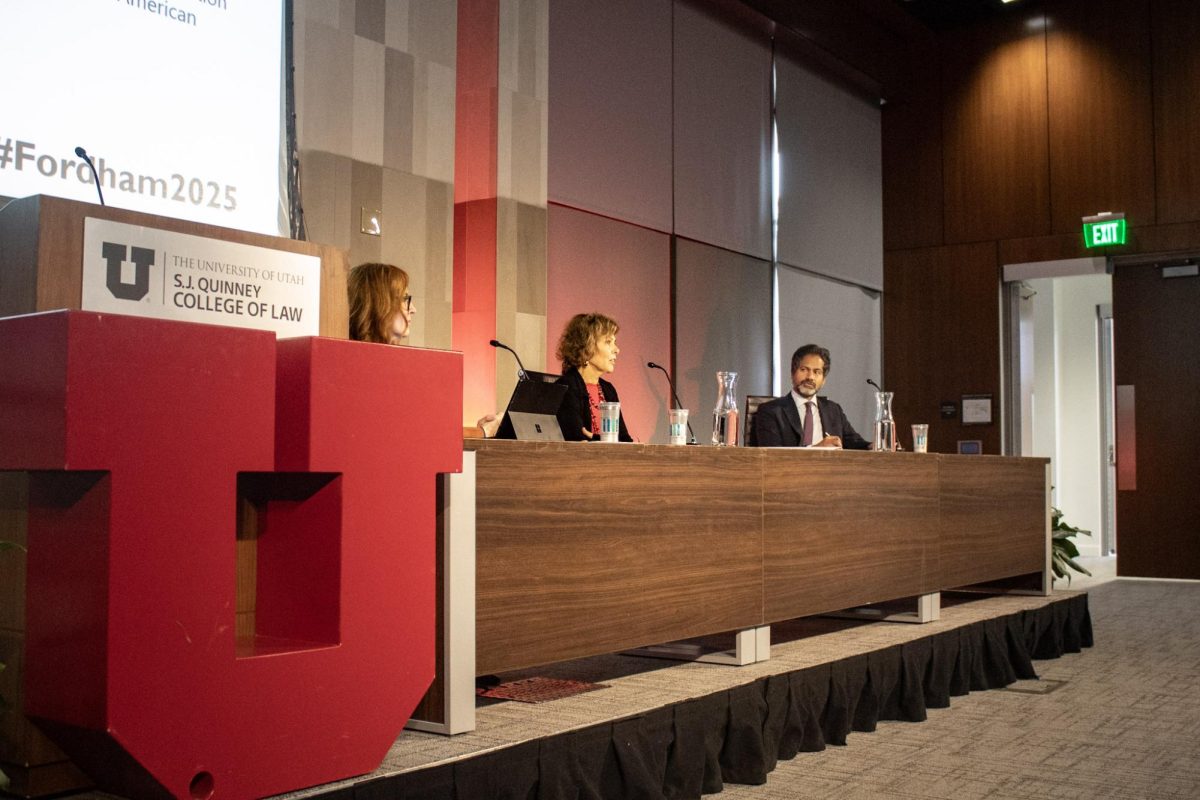
The 40th Annual Jefferson B. Fordham Debate commenced Thursday, Nov. 20 to discuss “institutional neutrality and other academic freedom controversies,” at the S.J. Quinney College of Law. The event, hosted by the U’s law school, featured a back and forth discussion between two lawyers with a mediator.
Context
Utate law requires universities to maintain “institutional neutrality,” which means “an institution of higher education does not take positions on political, social, or cultural controversies, public debates or flashpoint moments,” according to the Utah System of Higher Education.
The speakers, Nadine Strossen and Jameel Jaffer, are law professors at New York Law School and Columbia University, respectively. The event lasted 90 minutes, beginning with a moderated debate between speakers that concluded with questions from the audience.
After the debate, the moderator asked questions submitted by the audience, which ranged from the U’s academic partnership with Ariel University, an Israeli institution located in the occupied West Bank, to the U’s position on Charlie Kirk’s assassination, which took place 45 minutes south in Orem. Ariel University’s location is illegal per the Geneva Conventions, according to the United Nations.
Pro-neutrality
Jaffer, who spoke in opposition of a university’s obligation to remain neutral, argued that universities are unable to remain completely neutral, as they must make choices regarding how they spend their time and resources, as well as what other institutions they choose to collaborate with.
“This idea that universities can be neutral in their conduct seems incoherent to me,” he said. “Universities have to make decisions about what donors they’re willing to accept money from, where they want to invest their endowment, which speakers they want to honor at commencement or communication, which schools they want to form partnerships with.”
Jaffer is the inaugural executive director of the Knight First Amendment Institute at Columbia University and a professor of law and journalism. He formerly served as Deputy Legal Director at the American Civil Liberties Union.
Strossen spoke in favor of universities remaining neutral, and argued that a neutral institution promotes more dialogue and diversified politics on campus.
“Freedom of speech, intellectual freedom and robust discourse among the members of the university community … would be fostered if the university itself as an institution, through its president and through other leaders, maintained a policy of silence, not pronouncing with respect to controversial, social, political and cultural issues,” she said.
Strossen referenced the Kalven Report, a 1967 report on “the university’s role in political and social action,” from the University of Chicago.
Now a professor at New York Law School and senior fellow at The Foundation for Individual Rights and Expression (FIRE), Strossen served as president of the American Civil Liberties Union from 1991 to 2008. “In order to foster free speech on the part of all individuals, the university itself should refrain from making statements,” Strossen added.
Differing opinions
Jaffer criticized the Kalven Report, explaining that the two speakers had a different opinion on the role of a university. “Harry Kalven, who was the chair of the committee that wrote the report … said the university’s purpose is the production and dissemination of knowledge. And that may sound uncontroversial, but it turns out to be controversial,” Jaffer said.
He expressed opposing beliefs regarding the role of a university. “There are many others, many thoughtful people, who think universities are not just for the production and dissemination of knowledge,” he said. “They’re also to prepare students for participation in democratic life.”
He expressed concern with institutional neutrality, arguing that the principle hinders free speech. “I’ve become increasingly skeptical that this rule can actually help us decide when to speak and what to say,” he said. “I worry that the rule actually has the effect of obfuscating the factors that universities are actually considering in deciding when to speak and what to say.
The debate was mediated by RonNell Andersen Jones, a professor at the U’s Law School and Lee E. Teitelbaum chair.
Ariel University and institutional neutrality
The debate concluded with questions from the audience, submitted online to Jones. She began by asking the panelists about the U’s academic partnership with Ariel University.
“It’s clear that the question that the audience wants answered is for you all to chime in on a controversy that is brewing here on our campus and related to our university and institutional neutrality,” she said. “The University of Utah reached an academic cooperation agreement with Ariel University in occupied Palestinian territory, and the memorandum of understanding that the university entered into refers to it as being Israel, so there is controversy on the geopolitical landscape.”
Jaffer, who opposed institutional neutrality, answered first. “A cooperation agreement like this, I think, shows why applying a rule of institutional neutrality to conduct is incoherent, but a university has to decide, are we going to have a partnership with Ariel University or not? That is not a neutral decision,” he said.
Strossen followed. “It is non-neutral, but that doesn’t make it inconsistent with the purpose and scope of institutional neutrality,” she said. “I completely agree with Jameel, and I think it’s really important in every such situation, including any involvement with any foreign university … that the universities must be transparent about this.”
Strossen also expressed the importance of student media regarding situations like the U’s memorandum of understanding with Ariel University. “The new student newspaper can play a very important role in getting information and demanding information and stimulating debate and discussion,” she said. “First of all, we need basic information, and then second, we need discussion about the countervailing values that are at stake, what is to be gained, what is to be lost.”



Bear Sheldhorn | Nov 27, 2025 at 9:53 am
The university of utah is far from a neutral organization, and between partnerships with war-profiteering companies, association with gov. cox, the removal of resources for marginalized students, and a myriad of other dastardly behaviors it is evident that they are not trying to be. Why ‘foster diverse perspectives’ when you can make a profit? Why should an academic organization try to be neutral in a day and age where far-right viewpoints, despite being inaccurate to science and history, are running rampant and ruining american’s lives? When the coral reefs are being bleached from climate change? It is an incredible moral failure to look at the world around and posit that comfort to express a misguided opinion is more important than taking a stand to correct the fatal errors of the past.