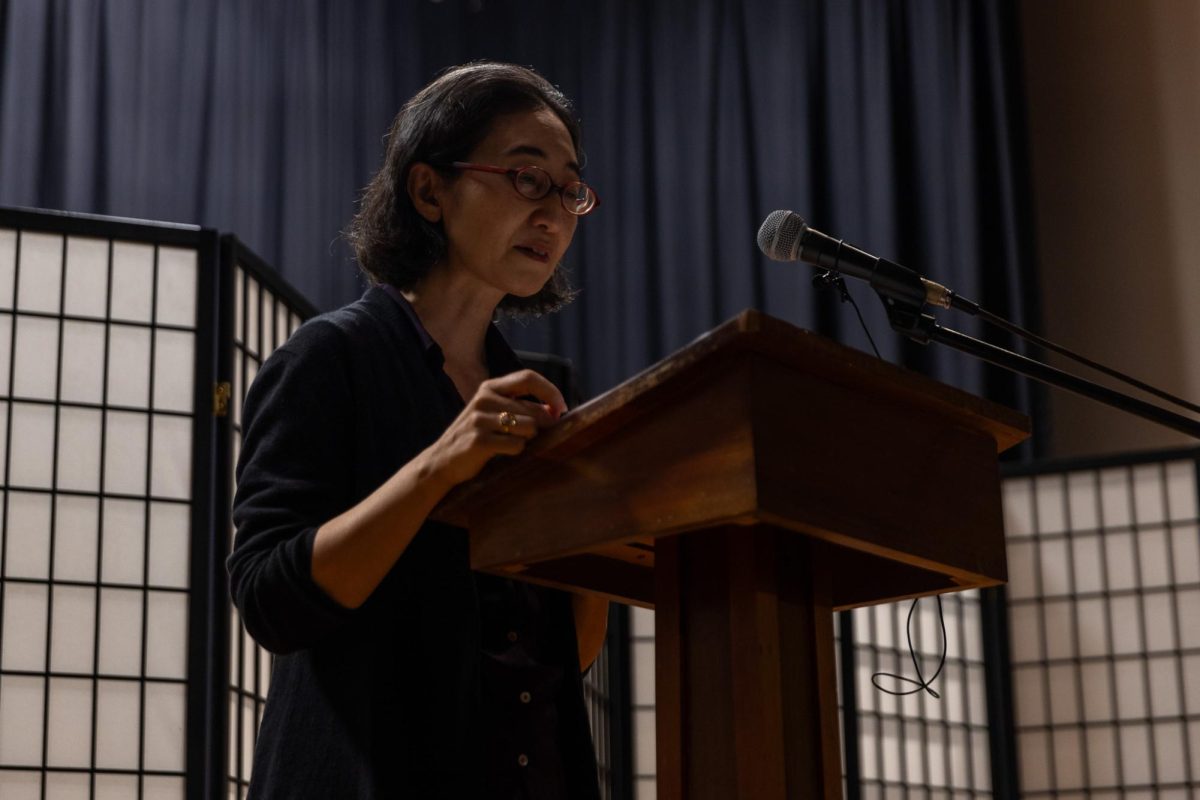
Art sometimes feels solitary, but a little bit of good old-fashioned campus programming can turn it into a public conversation. The University of Utah’s Guest Writers Series, hosted by the Department of English, operates with this exact idea in mind, bringing poets and prose writers to share work, teach, and meet the community in settings that often extend beyond campus.
Writers presenting their work
Every semester, distinguished writers and poets across the literary spectrum are invited to present their work, connect with audiences, and collaborate. Although sponsored by the U, events are open to the public and many are designed with community engagement in mind.
Alexander Ortega, vice presidential assistant in the English Department for the Guest Writers Series and related programs, describes the decades-long series, which are available to watch on the department’s website, as part showcase and part workshop. In addition to readings, invited guests often teach and review manuscripts. Programming typically includes a colloquium, something like a meet-and-greet, often held in the basement of Finch Lane Art Gallery. As Ortega described, one of the important ideas behind the series is bridging the gap between a more academic, form-minded sensibility and the needs of the broader community at large.
Recently, the series hosted poet, translator, and Brown University professor Sawako Nakayasu for a workshop in Salt Lake City’s historic Japantown. Ortega, who coordinated the event with Japanese American advocacy group Utah Japantown Advocates, explained, “I could tell right away that her work aligned a lot with the Creative Writing program’s artistic interests, in that it’s very conceptual. The Creative Writing program is both very rigorous but also really celebrates experimentation and innovation.”
Combining performance and prose, Nakayasu’s cross-cultural work engages language, memory, and translation, themes with particular historical significance for Japantown.

Salt Lake’s Japantown history
With a history dating back to the turn of the century, Salt Lake’s Japantown was once among the largest in the country, a thriving community and a source of pride for many Japanese-Americans after the hardships of migration and wartime internment. Despite that importance, most of Japantown was demolished in the late 1960s for new development, leaving a small stretch of 100 South and a handful of buildings.
“Yeah, it was just like any other ethnic enclave,” said Alex Hirai, a multi-generational Japanese Utahn and member of Utah Japantown Advocates, the group that partnered on the workshop. “The businesses and such started servicing the needs that the broader community couldn’t, because they [Japantown residents] were from Japan. Where we come in is after the Salt Palace was built in the 60s. That devastated the community, at least in terms of its physical centering. Today we see that those kinds of forces are coming again, so we just want to be more organized this time!”
Founded in April 2024 in response to legislation proposing a multimillion dollar entertainment district downtown, Utah Japantown Advocates has two main goals, according to Hirai. First, to organize Salt Lake’s Japanese American community and secure a seat at the table with the city and private developers. Second, to raise awareness of Japantown’s history through public-facing events like this workshop.
“Art doesn’t just happen; culture doesn’t just spring up out of nowhere, you have to invest in it!” Hirai said. “Not just monetarily, but you have to give space for people as well. I think the broader American public yearns for that sense of community, because we’ve lost it … I think art is a really important part of that because it brings people together, not just to do art but also because we’re all humans and love beautiful things. Having spaces to promote that is important!”
Sawako Nakayasu in Salt Lake
Well attended by a diverse group with varying connections to Japanese culture, the workshop began with Nakayasu reading a set of her poems. Originally composed in English while she lived in Japan, she later added Japanese elements in inventive ways, producing bilingual works that feel lived-in and humane.
“I think it’s important to support communities who have long been in a certain place,” Nakayasu said. “Japantown is deeply, deeply meaningful … They really want to hang on to the space that they have, the community that they built. I was really happy and really excited about the chance to support them and that energy around their community!”
Participants then wrote bilingual poems of their own. Nakayasu emphasized that “bilingual” is a spectrum, and that fluency and understanding vary widely. As a teacher of translation, she builds that reality into her practice. “‘Bilingual’ is kind of a limited term, and doesn’t actually describe anyone particularly well,” she said.
“One of the things I wanted to do in the workshop was to open up space for whatever degree of language and languages one wants to work with, and is interested in working with. Sometimes it’s just the sound of a language, sometimes it’s just a few words that are lingering in your mind. But there’s an openness to a creative act that does not demand absolute ‘perfection’ or completion, or ‘complete’ bilinguality.”

While the push for total assimilation may continue, Japanese-Utahns still have many avenues to maintain and pass on traditions. The arts help give voice to complicated individual experiences and bring people together across them.
For those developing a poetic voice, Nakayasu’s advice is simple: read. “There is so much out there now! Poetry in particular is doing a lot of wonderful experiments around multi-linguality, language, and literature. There are a lot of changes in the field right now, so I think it’s just a matter of research and reading. The literature of the U.S. is changing in so many exciting ways.”
For readers interested in Utah Japantown Advocates, there is more to come. “We are doing a lot of planning this winter to try and figure out our programming. Our org is trying to fill in the gaps when our communities don’t have a lot of events … The next big thing would be Nihonmatsuri,” Hirai said, encouraging volunteers for next year’s festival.