This article originally appeared in the Resolutions print issue, in stands February 2026. It has not been updated and some information may be out of date.
The local government is conducting studies to improve high-traffic areas, and the Utah Transit Authority (UTA) published plans for major updates across Salt Lake City.
The city is conducting studies in several neighborhoods to address traffic and safety-related issues. UTA is preparing for alterations to the city’s public transportation infrastructure, including a new TRAX line. Some of these projects may take decades to complete.
The city is gathering public input on how infrastructure should change and continues upgrading roads and transportation routes. The 2018 Funding Our Future program and General Obligation Bond funded the reconstruction of several roadways, including that of 2100 South. It is currently funding improvements on 600 and 700 North, which will be completed this year. The city allocated an additional $12.3 million to transportation and street upgrades in 2025, according to the Capital Improvement Program.
City planners are grappling with major long-term infrastructure adjustment ideas. “[I] refuse to be somebody who says no to big things … but I do think that we have to treat big things as the big things that they are,” transportation planner Joe Taylor said.
University neighborhood study
Kyle Irvin, transportation planner, will resume a study of the University neighborhood within the next several months. The study area spans from South Temple to 500 South and from 1300 East up to University Street. Irvin’s goal is for the study to encourage improving road conditions, bicycle lanes, crosswalks, sidewalks, and bus stops. He is particularly concerned about safety issues near Stadium Station, which has the highest traffic in the state.
“We do studies of these neighborhoods, so that when the opportunity arises … we have some context around what the design might look like and we have some public feedback that will inform the decisions we make,” Irvin said.
The city paused the study, however, after the Legislature passed SB 195 in its last session. Irvin said the bill prevents the city “from doing [anything that] they deem a ‘highway reduction strategy’ on a subset of Salt Lake City B-streets.” 1300 East is one of those streets.
The city is working with the House Transportation Committee to ensure the study can progress while complying with state law.
West-East connections study
Another study aims to address issues with the East-to-West connections in the city. The study is part of a US Department of Transportation program, the Reconnecting Communities Pilot Grant (RCP). The program seeks to improve “places where transportation infrastructure has disrupted communities [and] disrupted mobility,” Taylor said.
Major changes that would improve the divide include burying I-15 in a tunnel and creating a train trench along 500 W, according to the 2023 Connect-SLC-Plan. “So I think about it this way,” Taylor said. “You can take a train from England to France … so, you know, major transportation infrastructure projects … are, from an engineering standpoint, totally possible.”
The study is still ongoing, so final proposals are uncertain. Major infrastructure changes will be challenging because they would interfere with national railroads and interstate freeways, which the city does not own. That does not mean those changes are impossible, he said. “I don’t think that if … that’s what folks feel like is the real solution to the problem, that they should stop advocating for [it] just because it’s hard,” Taylor said.
UTA’s plans
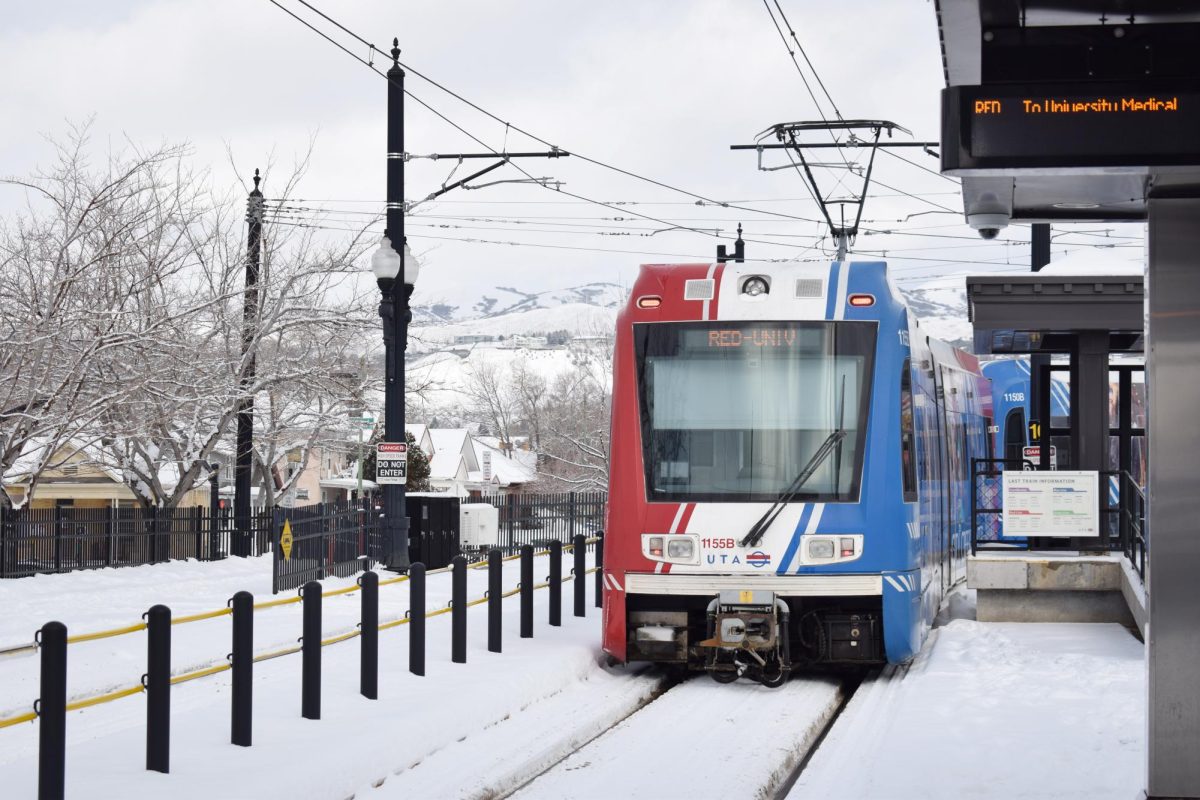
As part of the TRAX Forward Program, UTA envisions several changes to the light rail route. In partnership with the University of Utah and the Utah Department of Transportation (UDOT), UTA is working on creating an Orange Line that will run between Research Park and the Salt Lake International Airport. UTA will begin the “environmental and design phases,” although construction funding is not yet determined.
By 2027, the S-Line will extend into “the heart of the Sugar House business district” with an additional station at Highland Drive and Simpson Ave. UTA also plans to extend the Blue and Green Line terminals, as well as reroute the Red Line onto 400 West.
UTA’s current Five-Year Service Plan includes the creation of a rapid-transit busline, called the Midvalley Express (MVX), which will connect Murray, Taylorsville and West Valley. Its service will start on April 12, 2026.
UTA also seeks to improve TRAX’s general performance and reliability. It purchased 20 modern light rail cars and will invest in increasing the trains’ frequency and speed. Another project seeks to improve signaling systems. These updates will be used in “planning for future megaevents, including the 2034 Winter Olympics,” according to the UTA.