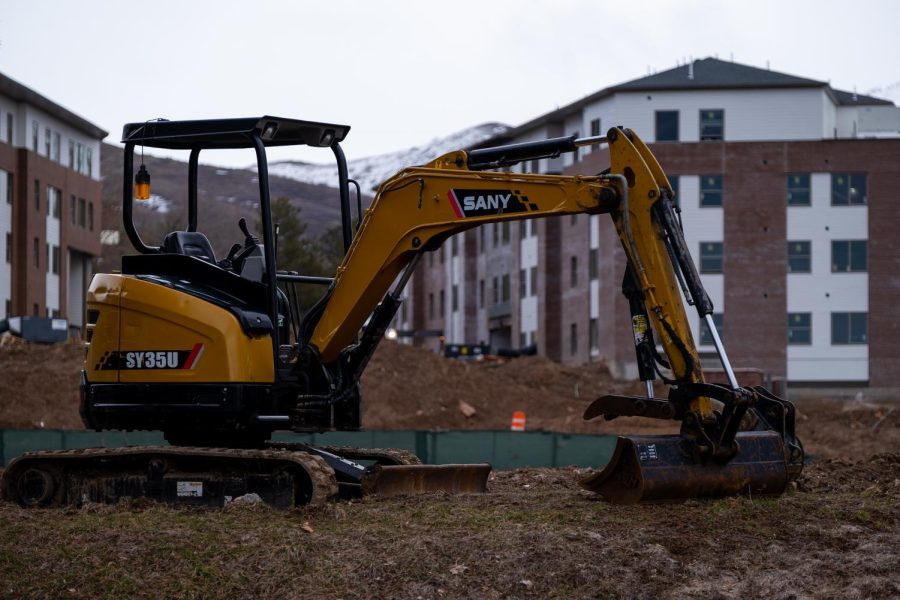
Prolonged construction on 2100 South and 1300 East — key roadways through Sugar House’s downtown — has pushed many small businesses into a challenging recovery period.
Launched as part of Salt Lake City’s 2021–2025 plan to upgrade aging underground utilities and “improve travel conditions for everyone,” the project has had lasting effects on the local business community.
The city originally scheduled completion for Nov. 2025. However, FOX13 reported on Sept. 25, 2025, that the work is nearing its end, with major roads such as 2100 South now cleared of construction barriers.
Effects on small businesses
Behind the city’s project, small business owners continue to voice concerns about the toll years of construction have taken.
Owner of Sugar House Coffee, Emily Potts, told The Chronicle that 1100 East closed for a year, and only a month after it reopened, construction began on 2100 South and 1300 East. With major routes blocked, she said her café saw steep losses. “We dropped about 35% in profit on some days,” Potts said. “It was harder during construction than during COVID, because it was just one neighborhood that was suffering, not an entire community.”
Adam Farr, the owner of Empanada Co., reported more than a 30% decline in business. “It’s been difficult,” Farr said. “Many companies have gone out of business because of the handling of this by the mayor’s office and the approvals the council gave.”
Chad Hopkins, SLC local and owner of Hopkins Brewing Company, described how construction made Sugar House harder to navigate and drove customers away. “Over the past two years of construction on 2100 South, we’ve lost nearly half a million dollars in sales,” Hopkins said. “I grew up in Sugar House when it was full of small businesses. After years of corporate expansion and now construction setbacks, many owners are worried about how to bring customers back.”
Cutting margins
Reduced foot traffic forced businesses to adapt. Potts said she had to cut her margins, or percentage of revenue.
“Our margins have definitely decreased,” she said. “Part of that is due to the construction, but inflation also drove our cost of goods up about 27%. We’ve raised prices a little, but there’s only so much you can do before it conflicts with your values.”
Farr said construction prevented Empanada Co. from hiring new workers and added financial pressure. He explained that the effects extend beyond individual shops, rippling across the city: lost sales lead to lost jobs and reduced tax revenue, and the city often shifts that burden onto remaining businesses. In recent years, he added, that has meant raising taxes, such as the additional 1% increase in the restaurant tax.
“Customers rarely see this side of the struggle,” Farr said. “Many assume businesses are simply hiking prices, when in reality most of us have tried to keep increases to a minimum.”
City response
The Daily Utah Chronicle reached out to the Governor’s Office of Economic Opportunity (GOEO) but did not receive a response.
Salt Lake City mayor Erin Mendenhall commented in a recent KSL.com article about the long-term effects of construction. “I think whatever lessons we’ve learned — good, bad, and ugly in Sugar House — are going to benefit every part of the city as we go through these major development projects,” Mendenhall said.
The city launched the Construction Mitigation Grant Program to help businesses facing construction-related hardship. The program offered $500 to $3,000 to cover marketing costs.
Hopkins, however, argued that the city did not do enough to protect Sugar House businesses. “They’ve given us grants, and they’re tiny grants compared to the damage that’s happened,” he said. “The city gave us a construction mitigation grant, which was $3,000,” Potts said. “Many of us laughed because that $3,000 is never going to save a small business.”
Farr echoed the concern. “Three thousand dollars doesn’t begin to address a 30% or more decline in revenues because of ongoing projects and construction,” he said.
Hopkins also criticized the city’s approach to signage. “The city did little to direct people around the closures, and it took me a long time just to get a sign,” he said. “At one point, they even put up a ‘sidewalk closed’ sign when the sidewalk was actually open. I had to move it myself. In the end, I’ve been left to handle nearly all of the marketing and visibility on my own.”
Next steps
With construction wrapping up, Potts said the community is looking forward to a fresh start.
To celebrate, the city will host Sugar Fest on Oct. 4, featuring punch passes for local food and beverage spots. “The goal is to bring people out to support Sugar House’s small businesses,” she said. “Sugar House fans are excited to welcome people back.”
Both Potts and Farr acknowledged the necessity of infrastructure upgrades. Still, Farr urged officials to weigh improvements against community impact. “Prioritize citizen experience,” he said. “Get the infrastructure projects done because they matter, but don’t do it at the cost of mobility and business operations. Be thoughtful. Take a common-sense approach. Put yourself in other people’s shoes. Practice kindness and thoughtfulness.”