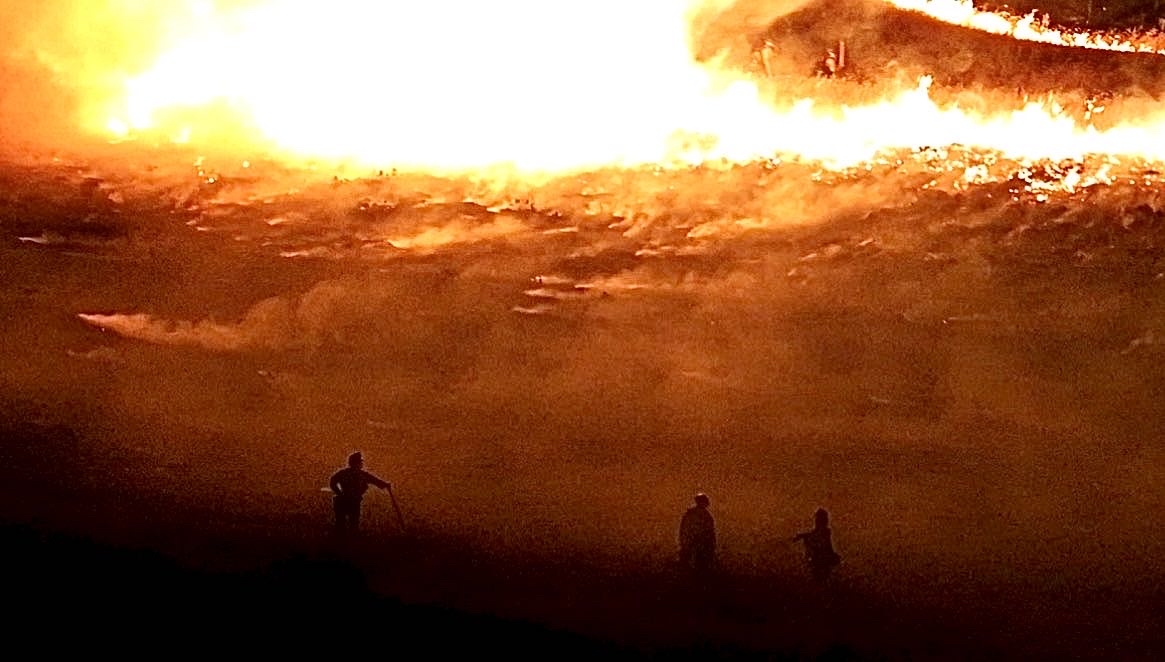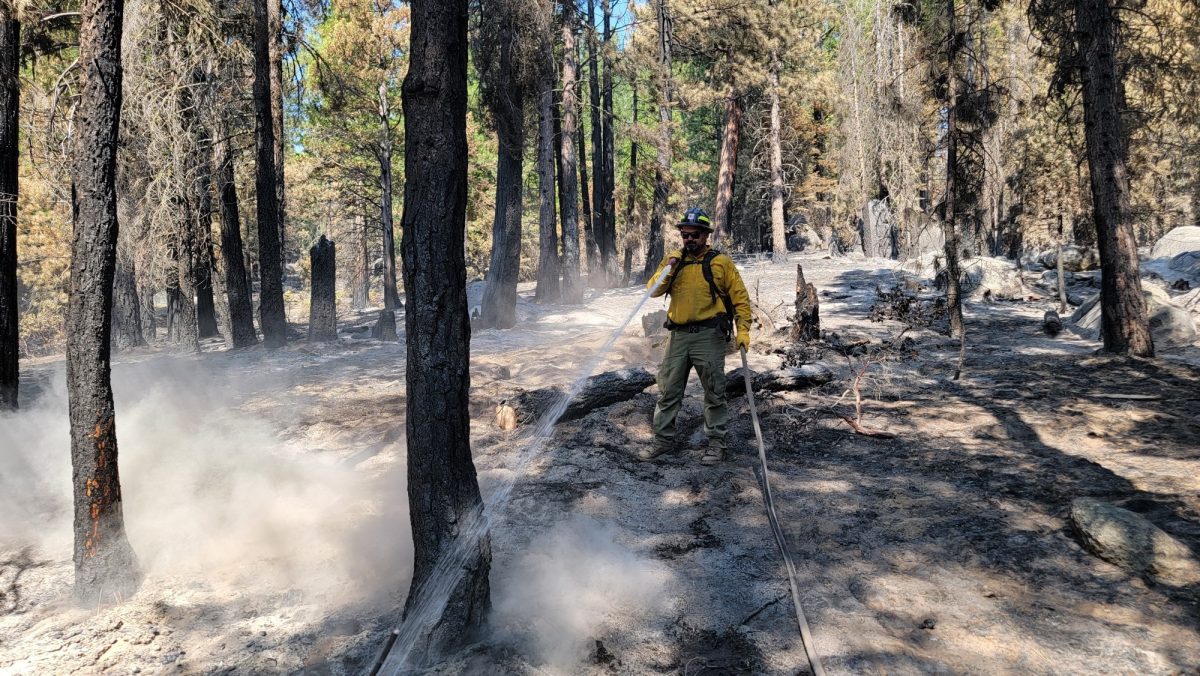
As wildfires and droughts become more prevalent throughout the Western United States, more and more homes are being exposed to wildfire risk. Wildland-urban interface fires (WUI) — a zone where human development meets with undeveloped wildland — can burn through entire neighborhoods within a few hours, a threat that has 91% of Western voters concerned about reduced firefighter resources.
Nicholai Allen, a wildland firefighter who helped fight the 2018 Woolsey Fire and 2025 Palisades Fire and created the fire safety product line SAFE SOSS, did a phone interview with The Chronicle to give insight into the world of wildland firefighting.
The force of a wildfire
When asked about the nature of fighting wildfires firsthand, Allen described fires as “the most humbling thing” one can experience. “It’s something that you just, as an individual, you don’t have the power to combat or protect yourself against,” he said.
Allen says he joined the force out of necessity when his home was threatened by major wildfires in California. “Just that panic was — just as a father, it was like, how do I get my head around this and what can I do about it?” he said.
Allen quickly began to appreciate the camaraderie and the complexity of fighting wildfires. “The more and more I got into it, the more I realized how hard people work in this space to protect us, how hard the wildland firefighters work,” Allen said. “How much knowledge there is of what they do, how they’re controlling fires with different fuel breaks and topographies and just how, how grueling it is.”
According to Allen, fighting wildfires is extremely unpredictable work. Fires can travel in one direction and suddenly switch directions completely. Allen said this is why it is so important to listen to fire authorities when it comes to evacuation orders.
“A fire could be traveling north, and you could see no smoke. And then all of a sudden — but the fire authorities might know that the wind direction is going to shift at 3 p.m. and it’s going to head south,” Allen said. “And so it’s going to go straight towards your community, and it’s going to be covered in smoke and it’s going to be low visibility.”
Escaping danger
Allen says evacuating is not a recommendation, but a demand for you to avoid a mortal mistake. “I know people that have waited too long and then they’ve burned up in their car,” Allen said. “I’ve seen loss of life from people who stayed behind with a trash pump and a fire hose in hand from their pool trying to defend their own property. But they didn’t know that they were at the top of a hill … all those hot gases and flames travel uphill with such force that you never stand a chance.”
In an interview with The Chronicle, wildland firefighter Kevin Johnson and the owner of a special operations fire unit described wildfires as being a sometimes-unstoppable force. “You’ve got a lot of big fires. Well, in a 100-mile-an-hour wind, you’re not going to stop it. No, that ember wash is going a half a mile out and ahead. It’s picking up football chunks of lumber that are burning and throwing them a half a mile out ahead,” Johnson said. “You don’t realize the amount of strength that these things can build.”
Johnson stressed the importance of having a bug-out-bag ready with all the essentials. “It doesn’t cost much to go down to Walmart, buy some chonies, some socks, a t-shirt, a couple of pairs of shorts, a toothbrush, toothpaste,” Johnson said. “You know what your essentials are. Have that bag sitting there year-round.”
Allen’s response: SAFE SOSS
After realizing how many homeowners lacked the ability to protect their property from wildfires, Allen came up with the product line Scientifically Achieved Fire Elimination by Science of Safety Systems, or SAFE SOSS. The company sells supplemental fire-safety products such as ember-guards, sealants and fire-retardant sprays that can connect to a garden hose.
Seeing how important it is to prepare for an evacuation, Allen realized that defense is just as important. “How come homeowners can’t just do their own fire retardant drops? How come some homes get the red stuff dropped on them, some don’t, some are saved, some are not,” he said. “Why can’t homeowners just do their own fire retardant drops? So that started the process of, okay, fire retardants exist, but they’re not convenient to apply.”
Johnson, an active user of SAFE SOSS’s products in his personal and professional life, appreciates SAFE SOSS’s non-toxic retardant formulation, unlike the classic red fire retardant dropped from planes, which can contain chemicals unsafe for the environment. “As far as SAFE SOSS goes, it’s way better for the environment,” he said. “And for me, what we’re doing is we’re trying to protect the environment for our kids’ future, for everything else.”
Johnson tested SAFE SOSS fire retardant’s ability to resist flames by coating dry hay bales during a fire, which came out unscathed. “It kind of shocked me when I saw that. I’m like, okay, this stuff’s working. It’s got good makeup,” Johnson said. “Is it a fix-all? No. But given the right amount of time with application, it did its job.”
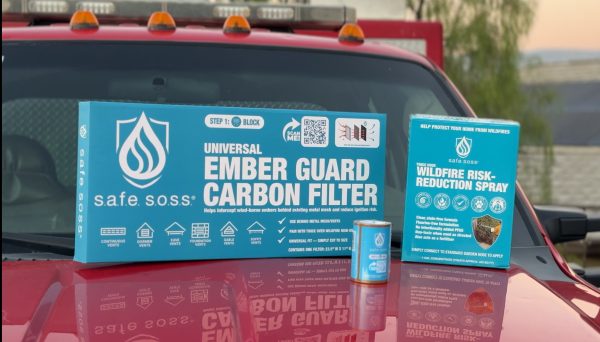
Allen also developed new ember guards after responding to the data that showed embers were the leading cause of home loss during wildfires.
What homeowners should know
Johnson wishes more people understood that “it’s the things you can’t see,” like vents. “Hollywood has done a great job of covering people’s thoughts of how this stuff burns,” he said.
Allen hopes to give people the tools they need to defend their homes against wildfires. Each SAFE SOSS product aims to increase the chances that a home survives a wildfire.
Allen believes preparing for wildfires is the most important aspect in battling them. “Part of your reluctance to evacuate is because you haven’t prepared properly. And to be fair, you haven’t,” Allen said. “But to tell you why you haven’t prepared properly, if you have the knowledge and the tools to prepare properly and to give your home that fighting chance and to have that peace of mind before you leave has not really existed.”
When homeowners properly prepare for wildfires, it can make it easier for firefighters to do their jobs. “If you pull up to a street and flames are approaching and you have to save all the homes, you’re gonna be able to save the homes that have basic preparations done,” Allen said. “We do recognize, you know, and we do appreciate the homes that have some preparation done, and it makes it easier to save them.”
Johnson seconded Allen’s appreciation for homeowner preparedness. “If you do this stuff as a homeowner ahead of time — it makes our job so much easier to come in and go,” he said. “The faster we can mitigate a house, the faster we can get to the next one because it’s just a giant leapfrog of engines as the fire progresses. Part of that is SAFE SOSS.”
The reward of a difficult job
Allen placed his appreciation of wildland firefighting towards his mentors and his brothers and sisters he works alongside. Duty and sacrifice helped him stay involved in his community, he said.
“I’ve been really lucky to have really good mentors,” he said. “I think that’s really why I’ve met so many genuinely good humans on fire that are there to really help people and protect property, and I really like that. I like being part of that community and doing what I can.”