This article is jointly published through Amplify Utah and the Great Salt Lake Collaborative, a solutions journalism initiative that partners news, education and media organizations to help inform people about the Great Salt Lake’s decline — and what can be done to make a difference before it is too late.
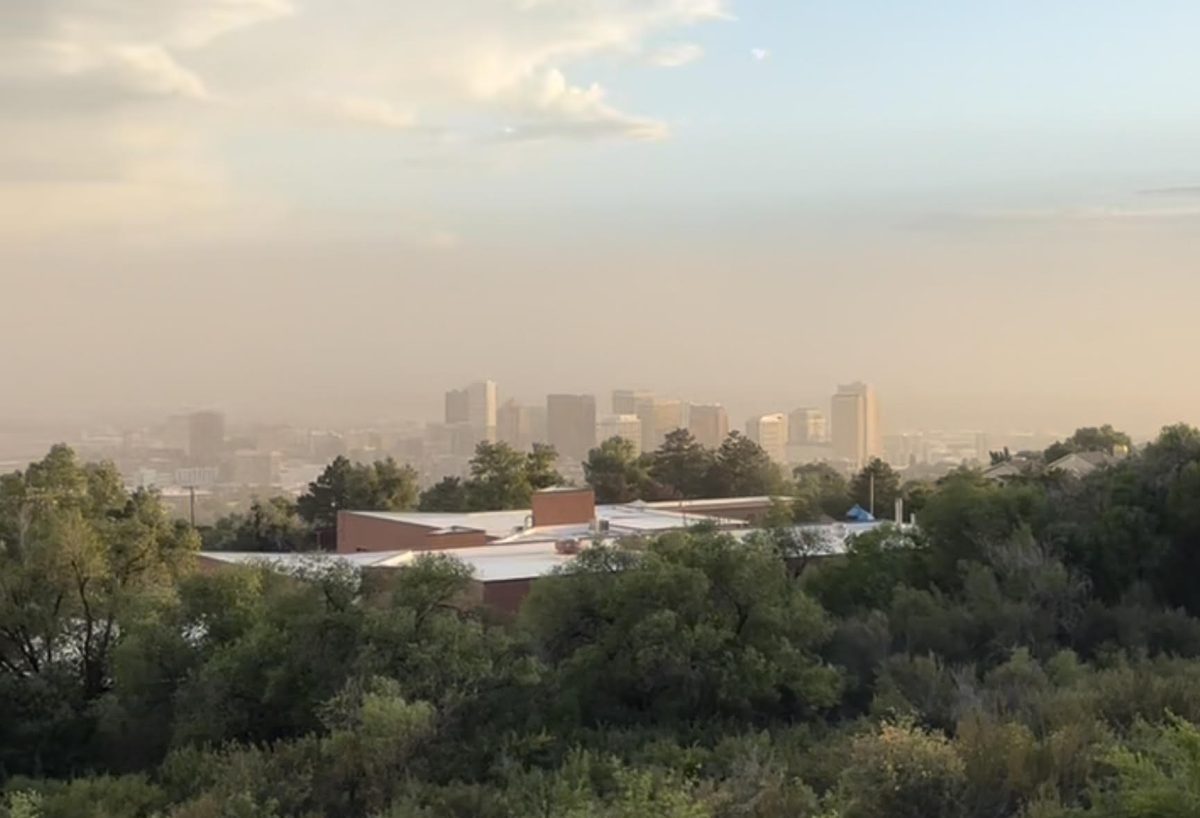
Last week, dark clouds of orange and brown dust blew down the Wasatch Front, darkening skies and reducing visibility for over an hour. It’s not the first time a Great Salt Lake dust storm has rolled through the valley this summer, and it’s probably not the last, experts say.
Dust from the Great Salt Lake’s exposed lakebed contains harmful pollutants like heavy metals, industrial mining runoff and residual pesticides, among other pollutants. When blown into the air, the dust can worsen air quality and pose serious risks to northern Utahns, especially the elderly, adolescents and those with pre-existing health conditions.
And as lake levels continue to drop — with over 55% of the lakebed exposed and water levels sitting at just 33% — researchers warn these dust storms are becoming more frequent.
The Chronicle spoke with University of Utah air quality researcher Kevin Perry and Bryce Bird, the director of Utah’s Division of Air Quality, to help Utahns prepare for these storms. Here’s what they had to say — and how the state is responding.
Identifying a storm
Great Salt Lake dust storms typically blow into Salt Lake Valley from the North, Perry said. He added that most dust events in Utah are a mixture from multiple sources, “but if you have plumes that are coming off the lake bed, then it’s pretty obviously Great Salt Lake dominated.”
In February, Perry’s research team at the U published a study on mitigation options and costs for Great Salt Lake dust. Perry himself has more than 23 years of air quality management and research experience.
“The first clue should be strong winds, that’s a big differentiation between dust and smoke because you don’t have to have wind to generate smoke,” Perry said. “The other thing is that it’s visually different from smoke. Smoke tends to create a milky white haze that covers the entire sky, and dust plumes are a little bit darker, they tend not to be uniform over the entire valley.”
Bird recommends Utahns “trust your senses,” adding that any gritty feelings in the mouth paired with reduced visibility may indicate a dust storm.
He also referenced the state’s air quality tracking website, which is updated hourly and the UtahAir app, available for download on any mobile device. Both provide alerts for incoming dust storms when forecast data is available.
Another key distinction is the consistency of dust plumes. Perry said Great Salt Lake dust storms, which are more dangerous, appear patchier than storms from other sources like Sevier Lake or the West Desert.
Protecting your health
Perry described two primary ways to protect oneself from dust storms: staying inside and wearing an N95 mask.
Most buildings have air filters in their heating and cooling systems that can remove dust and other contaminants in the air, he said, while an N95 mask can filter out 95% of airborne dust. “The most important thing is to identify it, and then you can protect yourself,” Perry added. “Generally speaking, the [Great Salt Lake] dust events typically only last a few hours.”
Perry also described two ways dust can impact human health. “One is an acute response. You have a big dust storm like we had last week, and people end up in respiratory distress, people end up with strokes, with heart attacks, those sorts of things — which are driven by the exposure to PM10 and PM2.5,” he said.
PM2.5 is a metric representing airborne particles 2.5 micrometers or smaller, while PM10 particles are 10 micrometers or smaller. A micrometer is one-thousandth of a millimeter. “The people that are most impacted are people with asthma, people with [chronic obstructive pulmonary disease], people with pre-existing conditions,” Perry added. “But at high concentrations, it can impact everybody, with the strongest impacts typically on the elderly and children.”
A 2020 Brigham Young University study found that air pollution from various sources in Utah “causes between 2,500 and 8,000 premature deaths each year, decreasing Utahn’s median life expectancy by 1.1 to 3.6 years.”
Drier lake leads to more dust
Dust storms from various sources are typical in Utah, but Great Salt Lake dust storms are becoming more common as more of the lakebed is exposed — and the crumbling salt crust uncovers more toxic dust.
“We know right now we get one to ten instances a year where we have dust that we detect, at the current monitors, originated in the Great Salt Lake,” Bird said. “We also have about that same number from West Desert sources, and about that same number from out-of-state dust sources as well.”
Perry said he expects more Great Salt Lake dust storms this year, but expressed uncertainty over the incoming monsoon season. “If the monsoon comes in and we get a lot of rain out of it, it can shut the dust down by wetting the playa,” Perry said. “If we get thunderstorms that don’t generate a lot of precipitation, that’ll just generate a lot of dust.”
Utah’s monsoon season typically peaks in the last week of July through the first week of August, Perry said, but can vary depending on different climatic factors.
“We’ve had an exceptionally hot and dry year. We had really low snowpack last winter that just allowed things to start drying out much faster than normal,” he said. “Last year we got really big monsoons, it completely shut the dust down and we didn’t have any dust events in the fall at all. But this year, the lake is ready to blow, all it needs is wind.”
Experts need more data
Existing dust monitoring stations are stationed in population centers like Salt Lake City and don’t collect precise data on what kinds of pollutants are in the dust. Perry said the historical lack of information has posed a challenge to researchers and state officials.
“We don’t have direct data for a lot of the communities that we think are most heavily impacted, what we have is atmospheric modeling of dust generation and transport,” Perry said. “We actually think that the hardest hit communities are those immediately northeast of Farmington Bay: Syracuse, Leighton, Clearfield, Farmington, Centerville…. those areas up there.”
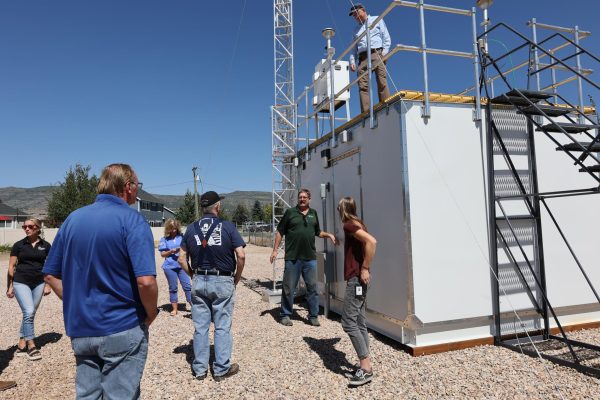
To fill the void, the state is installing new monitors along the lake. By the end of July, the Division of Air Quality plans to have eight newly installed Great Salt Lake dust monitors. Over five years, the division will have built more than 20 new monitors for the Great Salt Lake, Bird said.
“The first part of the dust monitoring that we’re doing now is adding PM10 monitors, both real time and filter-based monitors, to a lot of the existing monitoring sites that were there for other purposes,” Bird said. The goal is to install “monitors to be able to differentiate what is originating from the Great Salt Lake versus what’s being carried past the Great Salt Lake from dust events that originate in Nevada or in the West Desert,” he added.
The monitors will collect data in two different ways, real time PM10 data — which Utahns can access on the state’s existing air quality website — and filter-based monitors, which collect samples for lab testing.
“Dust Lake City”
Perry said additional data collection could help researchers offer better advice to state officials and people across northern Utah. “There’s a lot of obvious concern from the public, and that concern I think is largely driven right now by lack of data,” he said. “Once we have data, then we can do a much better job of assessing the overall impact that the dust is likely having on the people who live along the Wasatch Front.”
He also criticized sensationalized media coverage, explaining that a well-informed scientific approach to conservation is key to solving the problem. “Some media go a little overboard. I’ve seen headlines… ‘Dust Lake City,’ and the city will become unlivable because of dust, and that’s simply not true,” he said. “The dust events are very short-lived, and with some knowledge, it’s fairly easy to protect yourself from the dust. But we have to have the data in place and the alert systems in place and educate the public on how they can do that.”
Regardless, Perry expressed optimism for Great Salt Lake conservation, emphasizing water overconsumption is the leading cause for declining levels — which Utahns can prevent.
“Climate change is responsible for about 10% of the loss over the last 40 years, drought is responsible for about a quarter of the water loss, but two-thirds to three-quarters of the water loss is associated with using the water for other purposes before it gets to the lake,” he said. “That means that if we change how we use our local water, we can actually save Great Salt Lake.”