This article originally appeared in the Orientation print issue, in stands May 2025. It has not been updated and some information may be out of date.
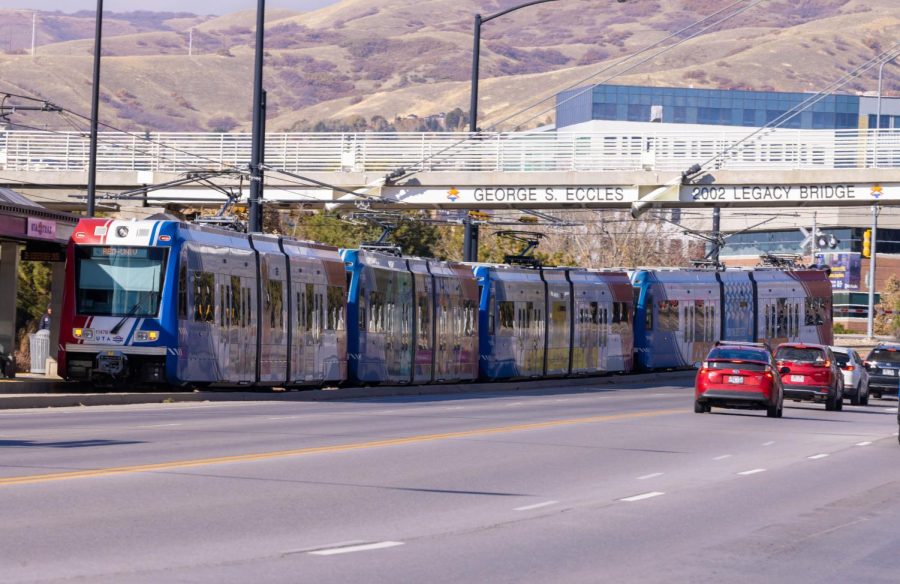
Being a University of Utah student navigating Salt Lake City without a car on a college budget doesn’t have to be stressful — or expensive. Thanks to a longstanding partnership with the Utah Transit Authority, all U students receive free public transit with their tuition. That means unlimited access to UTA buses, TRAX light rail and FrontRunner commuter trains, making it easy to explore the city, commute to campus and get around without the hassle of parking.
According to Gavin Gustafson, senior public information officer at UTA, the system is “shockingly easy to use” once students give it a try.
“We hear a lot of people say they were intimidated to start,” Gustafson said. “But once they use it once or twice, they realize how simple and convenient it really is.”
Navigating UTA
New students can begin riding UTA as soon as they have a UCard, which doubles as their transit pass. To make trip planning even easier, Gustafson recommends downloading the Transit app or using the Plan Your Trip tool on rideuta.com. Both tools give users detailed directions on how to get to their destination using public transportation.
“Transit will even tell you when to leave to walk to the bus stop or TRAX station,” Gustafson explained. “It takes out all the guesswork.”
Once you’ve figured out your route, your UCard makes it seamless — just tap it on the card reader as you board a bus or enter a TRAX platform.
Several UTA routes also directly serve the U. For example, the Red Line TRAX runs from the Daybreak community in South Jordan to the U’s Medical Center. Multiple UTA bus routes also connect the university to surrounding neighborhoods.
But for those commuting from farther away, the FrontRunner provides a high-speed option, running from Ogden to Provo. The FrontRunner runs every 30 minutes on weekdays and doesn’t run on Sundays. But, UTA is working on a double-tracking project that will allow trains to run every 15 minutes and introduce Sunday service in the future.
“It’s a game-changer,” Gustafson said. “You’ll be able to hop on a train more frequently and travel faster, which makes a huge difference for students living in other cities.”
For students concerned about safety, UTA has several measures in place to protect riders. For example, the agency has a dedicated police department, UTAPD, and deploys train hosts and transit ambassadors to provide assistance and monitor security on trains and platforms.
“There’s always someone either on the platforms or riding the trains,” Gustafson said.
To ensure its services stay up to date, UTA also reviews and adjusts its schedules three times a year: in April, August and December. Students can stay informed through the UTA website, sign up for text or email alerts or follow UTA on social media for announcements.
UTA also encourages feedback through its customer service portal, available online or by calling 801-RIDE-UTA (801-743-3882). While social media comments are seen, Gustafson emphasized that official service requests should be submitted through the form to be properly tracked and addressed.
Campus shuttle and commuter services
In addition to UTA’s services, the U offers its own free campus shuttle system. Chad Larsen, who works with commuter services at the U, recommends visiting uofubus.com. There, students can find real-time shuttle tracking, maps and schedules for all campus routes.
“The shuttle system works hand-in-hand with UTA,” Larsen said. “Students can use both to navigate campus and the city efficiently.”
With these tools, students can plan daily commutes, weekend outings or quick grocery runs, all without needing a car.
Special programs and student perks
UTA also offers a few fun extras. The “Ticket as Fare” program allows students and guests to use event tickets as valid fare on UTA trains and buses.
“For example, if your dad’s coming to a basketball game on campus, he doesn’t need to pay for parking. His game ticket will cover his fare on TRAX,” Gustafson said.
Promotions like this have also been applied to events like the Twilight Concert Series.
Looking ahead, UTA is planning an Orange Line TRAX to serve the University of Utah and expand service across downtown Salt Lake City, to the airport and into Research Park.
With free access to public transit, dedicated campus shuttles and trip-planning tools, students at the University of Utah have a set of resources to stay mobile, save money and reduce their environmental impact.
“The system gives students freedom,” Gustafson said. “You don’t have to live in Salt Lake to go to school at the U. You don’t have to drive. You can live where you want and still get where you need to be.”