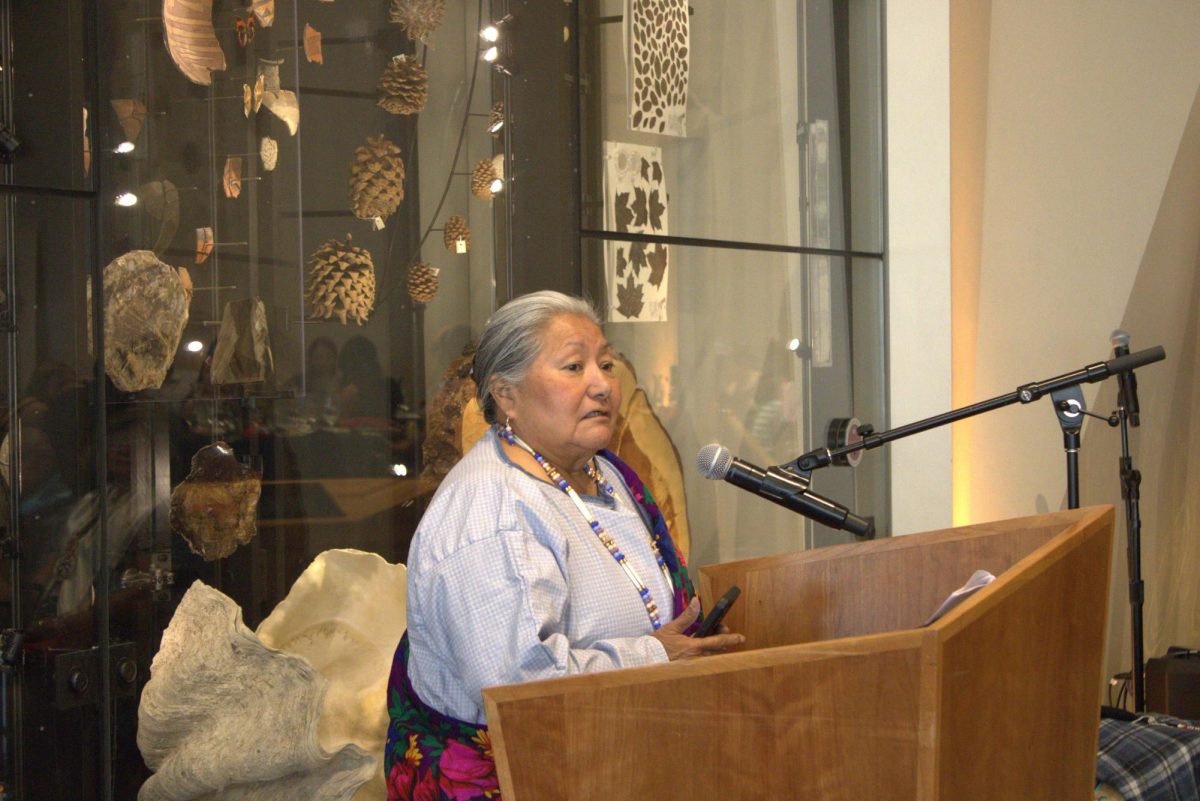
Scuba diver, world traveler, scientific pioneer and Smithsonian-honored biologist are just four ways to describe Dr. Phyllis “Lissy” Coley, a distinguished professor emerita at the University of Utah’s School of Biological Sciences. This year, Coley was selected by the Smithsonian Tropical Research Institute (STRI) to be honored for her work in Panama.
Coley’s work has advanced the understanding of how interactions between plants and herbivores shape tropical forest diversity. Her studies in plant ecology, herbivore behavior and chemical defenses have become central to explaining how biodiversity is maintained in tropical ecosystems.
Coley’s journey to biology
In Coley’s early years, she attended Hampshire College — an experimental school at the time — in Massachusetts. As a student of the college’s very first class, there were no grades, credits or classes. Coley said, “As someone who had always done anything for a good grade, I found myself wondering, ‘Who is going to know if I learn anything?'”
“Finally, I was helping a friend do some project on a little stream,” Coley said. “It was November, and I was standing in this stream, and it occurred to me: I would know if I learned something. [It] was probably the best light bulb ever.”
Coley graduated from Hampshire College in 1974. After she took some time off from school, Coley worked as a scuba diver studying the environmental impacts of a nuclear power plant. She later pursued her graduate degree at the University of Chicago, where she also earned her doctorate.
“I had two choices: one was going to the University of Chicago and studying tropical biology, and the other was going to a university to study municipal sewage treatment,” Coley said. “Who knows, maybe I would have really liked sewage, but I certainly ended up loving working in rainforests.”
Working around the world
Coley’s research has taken her all over the world. Alongside her late husband and colleague, Tom Kursar, she conducted fieldwork in Panama, the Amazon, Peru, Brazil, Ecuador, French Guiana, Borneo, Malaysia, Zaire, Congo, Cameroon and Uganda.
The two spent a year on sabbatical, camping in forests across these regions to study how young leaves affect their ecosystems and the medicinal qualities they possess. “We were sick pretty much the entire time with all sorts of nasty tropical diseases, but it was worth it,” said Coley.
After their sabbatical, Coley and Kursar sought additional funding for their research. They ultimately chose to continue their work in Panama.
While studying the defensive properties of young leaves in tropical rainforests, a question arose: how would their work conserve rainforests and contribute to drug discovery? Coley and Kursar wanted to know more.
“We thought if we could move some of this drug discovery research to Panama, Panamanian scientists could get more opportunities to actually do research, and there would be [an] immediate, bigger benefit than the alternatives like logging and mining,” said Coley.
At the time, university research in Panama was not common. With a small grant, a few folding chairs and a dedicated team, Coley and Kursar began their work and brought their vision to life.
“It was a success beyond our wildest dreams,” Coley said. “We slowly built up this program, and we established independent labs in Panama. This crazy idea that Tom and I had ended up being so wonderful.”
Recognition and awards
Fifteen years of work later — and not a cent earned from the project itself — the couple’s vision became a reality. Recently, the STRI honored Coley for her contributions.
Barro Colorado Island (BCI) in Panama is considered the “crown jewel” of STRI. Several major research trails are located within the Barro Colorado Nature Monument, the most studied tropical forest in the world. Last year, the STRI celebrated its 100-year anniversary.
Erin Spear, staff scientist at the Smithsonian Institute and former student of Coley, said, “In doing [the award] we really reflected on the people who had shaped and changed BCI, so obviously Lissy is one of them.”
The seven trails have all been renamed. What once was known as the “American Museum of Natural History Trail” is now the “Phyllis D. Coley Trail.”
Spear said that this accomplishment reflects how far women have come in this field of science. “In the beginning, they wouldn’t even allow females on the island to do research because that would lower the intellectual environment, as the men would love to say,” said Coley. “Many years after, they finally allowed women to work on the island and, of course, all the trail names were for white male professors because they were able to get there first.”
“Lissy and I had a really important and meaningful conversation about how far we have come, how far women have come in their careers and what we are capable of now,” Spear said. “She is a great role model, she has achieved so much, she never stopped and she absolutely loved what she did.”
Coley said that STRI’s recognition is the “greatest honor” she could have been given. She was able to spread her late husband’s ashes around her trail and is hopeful for the future of the organization that she and Kursar contributed so much to.