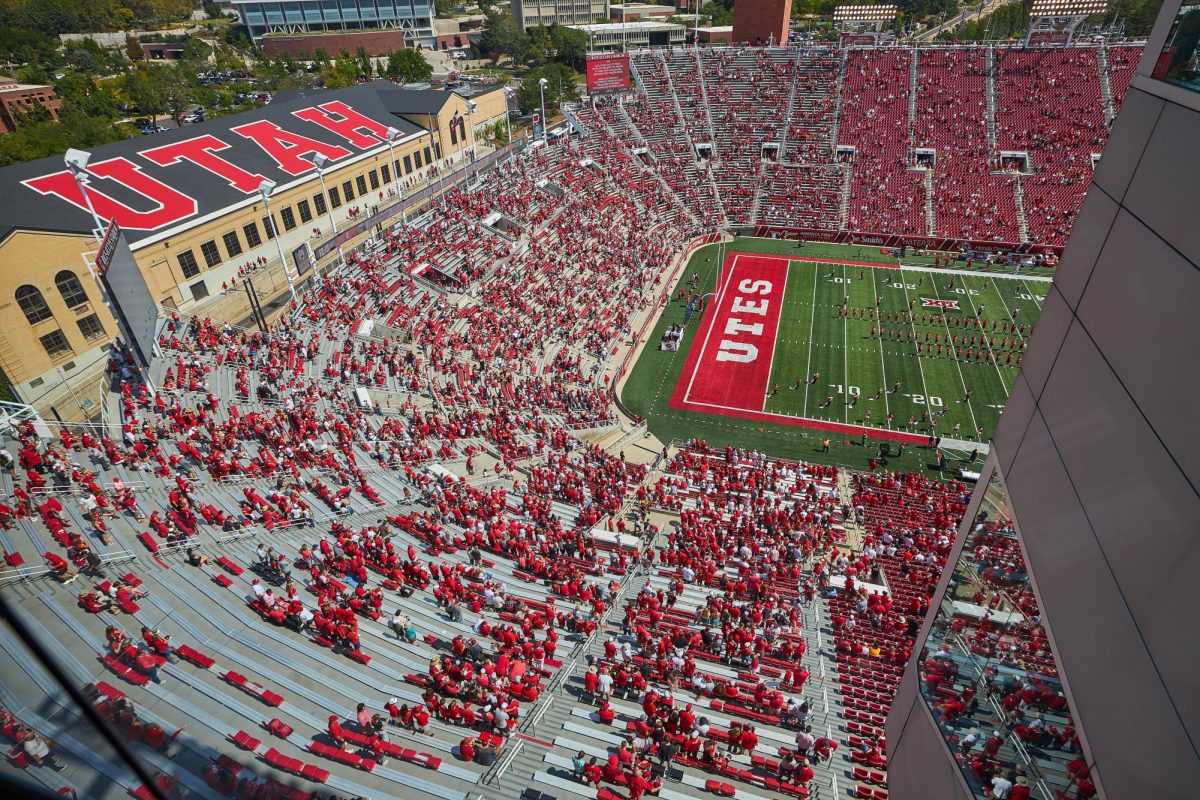
Recycle Rice-Eccles was discontinued earlier this year in exchange for a university-led effort. The initiative, led by ASUU, involves bringing volunteers together to clean up Rice-Eccles Stadium during game tailgates. Today, clean-ups are done by paid staff and recycling stations are built at all the tailgate lots to encourage recycling.
Recycle Rice-Eccles began in 2009 when ASUU Sustainability Board Director Dave Burt organized volunteers to recycle litter around the stadium. The initiative collected almost 21,000 pounds of recyclables in one season and earnings from collected aluminum cans were used to support future sustainability projects. Student volunteers were also offered free admission to games.
How the change came to be
This change in sustainability efforts was made last year as the sustainability board met with the stadium to move away from relying on student volunteers. Sierra Canela, the director of student governance and leadership at ASUU, explained her perspective on this switch. “Last year was the first year that the stadium took on recycling, so we stopped doing it, but it was actually a win because now the university is doing it. It’s not that this isn’t something students don’t care about anymore, it was ‘oh, the university is taking this on, now we can focus our sustainability efforts on other areas of campus,” Canela said.
This move reflected the attitude the U’s Department of Public Safety wanted to incorporate into football game culture. This shift occurred after concerns arose about disruptive activities on game day. “Over the past couple years, we’ve been in conversation with the Rice-Eccles Stadium and the athletics team to talk through ‘What does it look like to have recycling established in the lots so students don’t have to go around with bags? How can we build infrastructure so that it’s embedded in the tailgate culture that you recycle?’” Canela said.
Sustainability efforts on campus
ASUU’s Sustainability Board focuses on working with students and university officials to promote sustainable practices. ASUU also hosts other initiatives like Eco Fest, where sustainability-focused clubs and departments can promote themselves and their messages. Director of the Sustainability Board, Jasmine Malhi, explained the significance of the board’s work for students and the campus. “We’re working on a lot of different elements to hit our goal of creating a cultural shift on campus towards sustainability and showing how it’s important,” Malhi said. “When we attend a school where students are so outdoor-oriented, it’s not the sentiment of conservation and sustainability that’s missing. But rather, the idea that you can take those sentiments and turn them into tangible actions.”
The U released a Climate Action Plan in 2010 that details the U’s work in contributing to positive climate outcomes. The plan also expands the U’s Climate Resilience Assessment. Malhi compared ASUU’s sustainability efforts to those of other universities’ student governments. “I noticed that not all of these schools even have a sustainability board. I think the university also does well in their commitments outlined in their climate action plan. A big example is how 70% of its energy comes from renewable and clean energy, which is amazing,” Malhi said. “It affects so many things like new infrastructure developments, retrofitting, all those things. I’m glad the university is taking those steps and positioning itself to be a steward in sustainability.”
Work to be done
The Sustainability Board has drafted two pieces of legislation to be passed by next semester. One of which aims to replace paper towel dispensers with Dyson hand dryers and the other aims to phase out single-use plastics with dining vendors. Malhi shared her thoughts on why students should care and practice sustainability. “Something I’ve been trying to emphasize this year is being mindful in regard to sustainability. We have the privilege of not seeing a lot of the negative effects that are caused by a lack of awareness or mindfulness for sustainability. When you take a step outside bubble, you see how a lack of conservation affects communities and parts of our land detrimentally. Our actions should reflect our demand for equity, equality, inclusion and justice. I think in order to do that we need to position sustainability at the forefront of our priorities,” Malhi said.