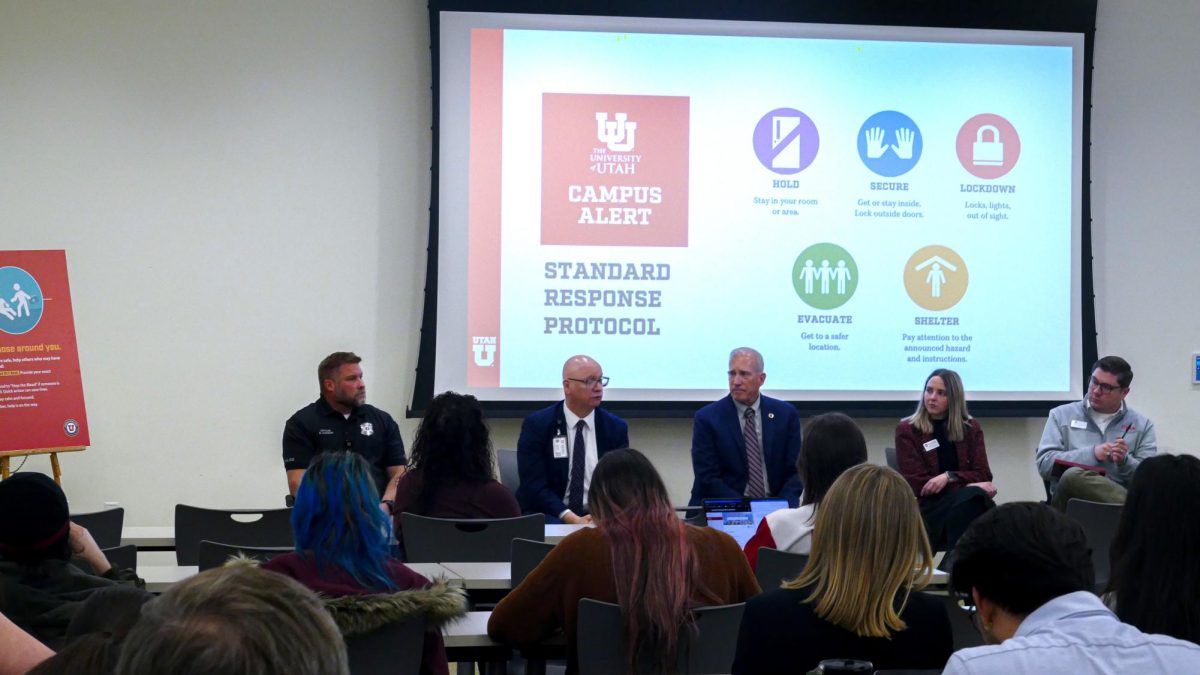
On Wednesday, Feb. 25, the Associated Students of the University of Utah (ASUU) hosted a public safety panel to help students learn more about campus safety and how the university’s various safety departments collaborate to keep the campus community safe.
Speech by Squires
The town hall began with a brief speech from Chief Saftey Officer Keith Squires. Squires joined the university a year after the death of Lauren McCluskey. He previously participated in the investigation into how the institution needed to improve in the wake of her death.
Squires, who has worked at the university for five years, emphasized the department’s progress. “The department that existed five years ago is not the department that you have today,” Squires said. He added that the U’s safety department is now sharing information and practices that are being used as models by other higher education institutions.
Squires discussed the Threat Assessment and Management Partnership (TAMP), a Department of Public Safety program that brings together multiple campus departments to identify, assess and address concerning behavior that may indicate a risk of violence.
Panel discussion
The panel, led by Cameryn Coffey, ASUU’s director of academic affairs, opened with brief introductions of the panelists.
The panel featured Stuart Moffat, director of Emergency Management; Officer Ben Harmon of the University of Utah Police Department; Anna Dickherber, director of Housing and Dining; Stephen Henninger, director of the Office of Residential Life, and Squires.
Resident safety
Dickherber and Henninger represented campus housing leadership, overseeing student experience, residence placement and safety within on-campus living communities. Dickherber stated that safety is their highest priority for students living on campus. “We work closely with our partners represented here on the panel to help ensure you’re safe while you’re here.” she said. “According to Maslow’s hierarchy of needs, if you don’t feel safe, how can we expect you to succeed as a student?”
In a question regarding how the campus can come together to support student safety, Dickherber brought into the discussion the idea of gun safety. Passed in 2025, HB 128 allows those over the age of 18 and with a valid Utah concealed weapon permit (CWP) can legally carry concealed or open firearms on campus.
Dickherber noted that while weapons are permitted under state law, students are encouraged to communicate with roommates about firearms before moving in. Housing does not indicate whether a roommate plans to bring a weapon, but students can reach out ahead of time to discuss concerns. If uncomfortable, they may request a room change before move-in or after arrival by working with their resident director. Dickherber said the goal is to ensure students feel safe and comfortable in their living environment.
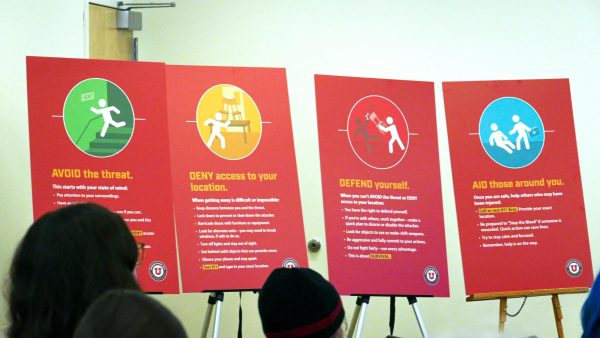
Campus alerts
Moffat addressed the human element involved in issuing campus alerts, explaining that while the department strives to send notifications as quickly as possible, mistakes can occur. He added that officials must also consider how alerts affect the hospital and other university operations beyond academics when deciding how and when to send messages.
“We’re human, we make mistakes. But we care, and we’re always working to improve,” Moffat said. “When something doesn’t go as planned, we meet with our teams to debrief, review what happened and ask what we could have done better. Then we make those changes.”
Squires also referenced a swatting incident in November 2025, when the university was notified of a call to the Salt Lake City Police Department’s non-emergency line reporting a stabbing on campus. After officers investigated and found no evidence of a crime, the report was determined to be a false call, later classified as a swatting incident.
“There were shortcomings in November. I won’t make excuses, we can and should have done better in how we communicated with you,” said Squires. “Since then, a lot has changed. We’ve made significant improvements behind the scenes, including how and when alert notifications are sent. We now have prewritten messages available in dispatch that can be pushed out immediately.”
ICE presence on campus
During the Q and A portion of the panel, a student asked how the university is addressing safety concerns among students of different immigration statuses following recent events that took place in Minneapolis. In particular, they asked about the presence of U.S. Immigration and Customs Enforcement (ICE) agents on campus.
Squires said he spoke with the regional director of ICE in early February to ask whether there was any possibility of ICE officers coming onto campus.
According to Squires, ICE officials have stated they do not conduct enforcement actions at K–12 schools or higher education institutions, and that this policy remains unchanged. He added that he regularly checks for updates and would respond if that position were to shift.
“If they’re actively pursuing someone and that pursuit happens to come onto campus, that’s different. But those are situations we manage with other agencies as well, we work to control the scene and keep everyone safe.” said Squires. “As of now, that’s the policy. In my experience, when an agency makes that kind of commitment, they communicate with us if anything changes.”
Future of public safety on campus
The Daily Utah Chronicle asked panelists how they envision the future of public safety on campus.
Squires said he hopes to break down barriers of distrust between students and the Department of Public Safety.
“We want to work together to identify when someone is in need and connect them with the right resources,” Squires said. “Compared to a city, we have phenomenal support systems and so many opportunities available right here on campus.”
Dickherber encouraged students to play an active role in promoting campus safety by avoiding the bystander effect and speaking up when they have concerns. “When you notice trends or have concerns, like questions about gun safety education, please bring them to us,” Dickherber said. “Share them in forums like this or with ASUU and RHA. We’re not your age, and there’s naturally some distance there. If you let us know what you’re seeing, we can make sure we’re addressing it. We try to stay aware, but we don’t want to miss anything.”