University of Utah photography professor Roger Tuttle built a homemade “camera obscura” in his driveway and presented it to the campus. A “camera obscura” is the earliest ancestor of the camera; it works by light traveling through a small hole or lens and then reflecting inside an enclosed space. The idea was founded by Iraqi scientist, Al Hassan Ibn al-Haytham, when he was sitting in a room with no windows but a hole in the wall.
“He sees an image projected on the back wall,” Tuttle said. “And so, he spends the rest of his life trying to discover how light works. He discovers that light travels in straight lines.”
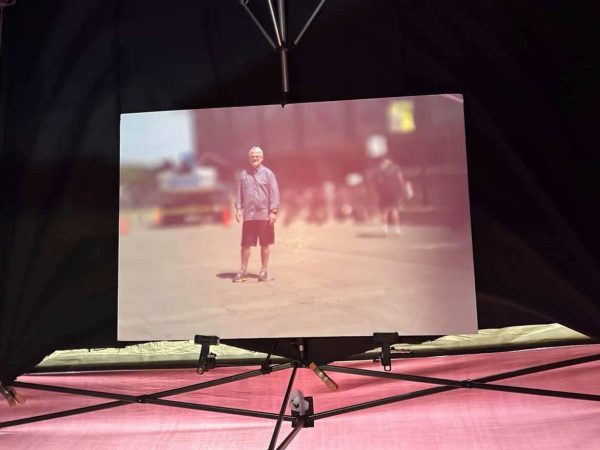
As the light comes through the lens, the image is inverted on the surface inside the closed space. Inside the tent is a large white panel that would be equivalent to film or a sensor today. Tuttle was alongside his students in his Photographic Lighting class, and their reactions were priceless.
“I expected something else,” student participant Keenan Dunn said. “I was pretty surprised how much just one little glass lens can project something just out of nothing. It was pretty cool.”
“I was like, ‘Whoa, okay.’ I think it gave me a lot of perspective into photography itself,” student participant Frankie Brandt said. “In many different classes, I’ve learned about camera obscuras and the history of photography. But then, actually, like, stepping inside of it and really breaking down the fundamentals of how it works, is what’s really cool.”
-
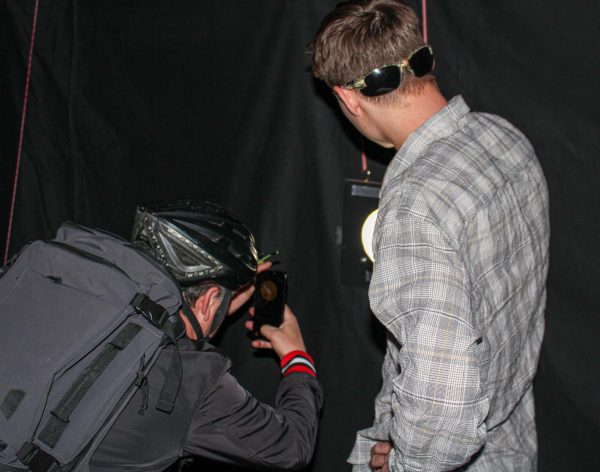
Observers taking a photo through the camera obscura’s lens. (Photo by Zack Pinter | The Daily Utah Chronicle) (Zack Pinter)
Timeless
In the modern day of age, analog photography like the camera obscura isn’t as relevant due to new technology and the features of digital cameras. But is it about the image, or is it more about the art? The true process and principles of how a photograph is produced are what a camera obscura represents and that’s something timeless.
“No matter how good technology is or how bad it is, seeing the purest form of those fundamentals is so cool,” Brandt said.
“A lot of times we talk about history and principles and things like that, right? But we never get our hands dirty,” Tuttle added. “And so this has been kind of a process to show, physically, what we’ve been talking about in the classroom. So, students get a chance to share the history and the information about the camera obscura.”
Aha!
In the end, it wasn’t about seeing the image but understanding it. The camera obscura was a chance for students and others to step inside the tent and see something abstract turn into something real and tactile. Their experiences inside the classroom were able to unfold in front of them.
“They step inside, and it’s not what they expected and they think it’s crazy,” Brandt said.
“The students get to experience that ‘aha’ moment that teachers live for. That’s like laughter to a comedian, right? You can’t buy that stuff. That’s the legit thing about teaching and learning is you hear that “oh, wow.” So that’s what’s been really cool about this,” Tuttle said.