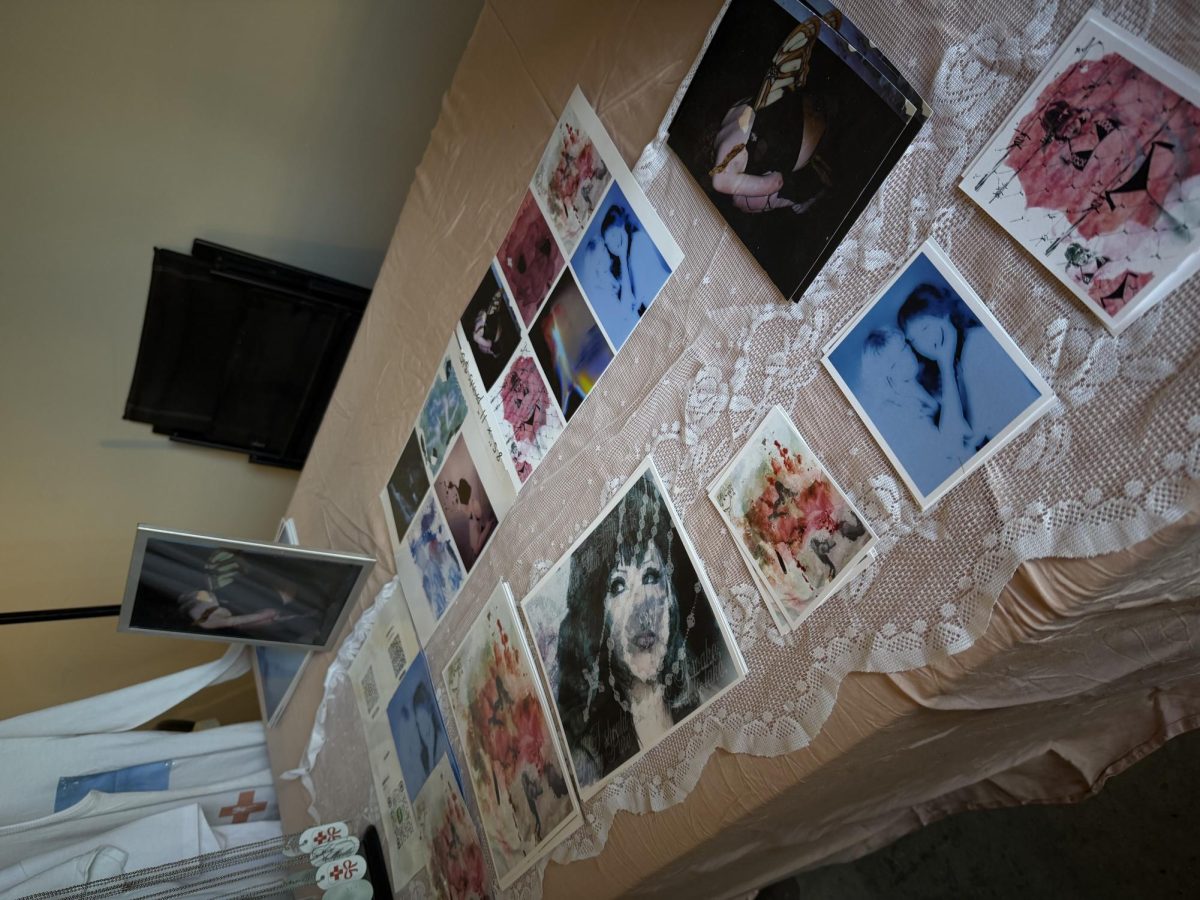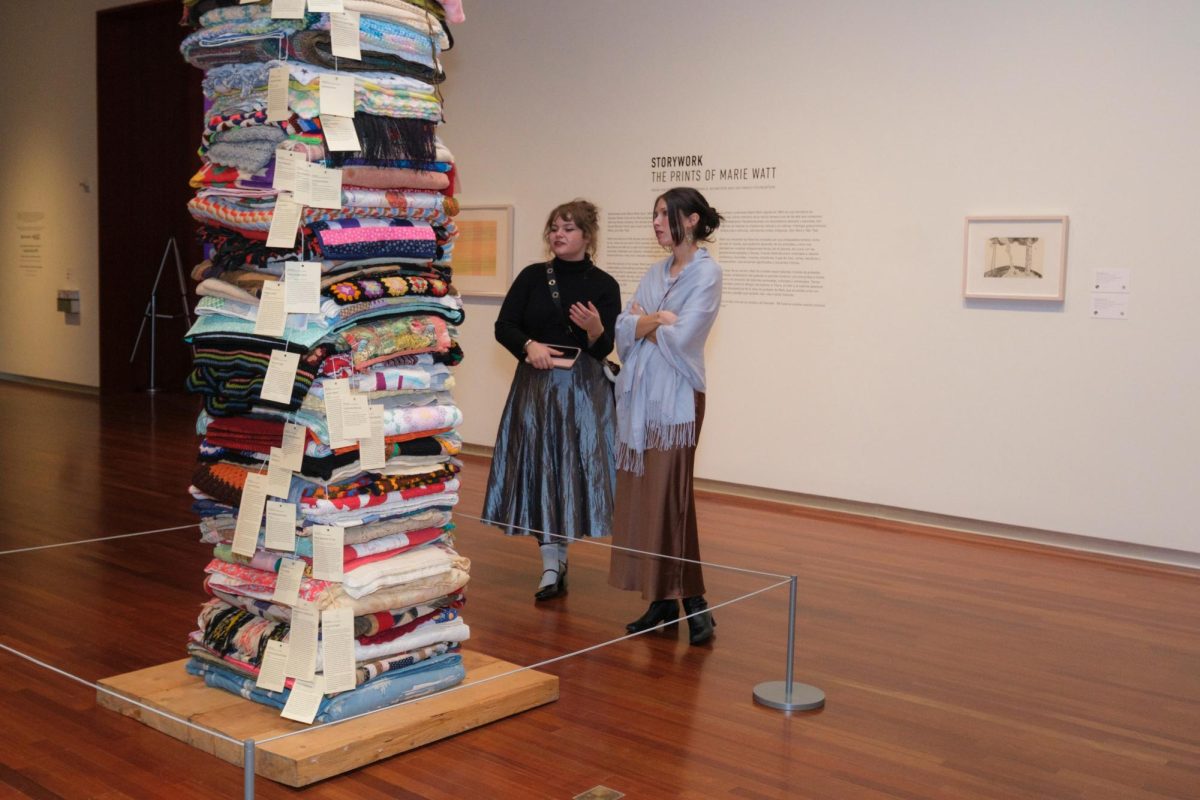
Blankets tower overhead, surround the walls, and are set in prints, sculpted and even carved into a three-dimensional infinity symbol. In addition to blankets, jingles, I-beams and various prints all fill the gallery. Each medium shares something in common — stories.
“Storywork: The Prints of Marie Watt” is on exhibition now at the Utah Museum of Fine Arts through June 21. Watt is a contemporary artist whose work explores themes of community, indigenous identity and history in a variety of mediums. The Jordan Schnitzer Family Foundation brought her work to the UMFA.
“Storywork means being a custodian of stories. I think we all have that responsibility,” Watt said. “A responsibility to learn our stories and make new ones. And also think about how our stories and the stories we make are going to impact future generations.”
Blankets and personal stories
“I was thinking of them as tubes of paint,” Watt said about blankets, which are central in her work. When people gave her their blankets, they would tell her stories about who they belonged to. Blankets are deeply personal. They are with people at birth, at death and every stage in between. They migrate and relocate with their owners, and they take on the form of people’s bodies. Watt wanted to explore this connection in her work.
Some of the blankets she used had a direct tie to Utah. She sourced some of her wool blankets, which are highly valued in some Indigenous communities, from the now-closed Baron Woolen Mills located in Brigham City, Utah.
Beyond the blankets
The exhibition also includes a tall I-beam sculpture, large textile pieces, numerous prints and work that incorporates jingles.
Watt wanted to explore how, similar to food and music, she could fully engage the senses with her visual art. The Jingle Dress Project inspired the jingles in her work. The sound the jingles made when they hit each other was said to be healing. The tradition started during the influenza pandemic with the Ojibwe people and quickly spread.
The I-beam sculpture took inspiration from the history of the Haudenosaunee people, who helped build much of Manhattan. Since steel is recycled so often, parts of the sculpture may have been from steel that was a part of Watt’s own ancestors’ stories.

About Marie Watt
Universities create a space where many people’s stories can “mingle and grow,” Watt said. She presented in the past at BYU and other college campuses. What she likes about universities is that “everybody’s a teacher and everybody’s a learner.”
“My story changes when I know your story,” Gordon Bettles once said. Watt often references his quote, and it can be seen throughout her work.
She facilitated storytelling within communities by hosting events similar to the print circle she hosted at the UMFA. Participants worked side by side and exchanged their stories while they created work that Watt will use in her future projects.
“I don’t think we should take for granted that we can tell our stories. And I also think that hopefully educational institutions create a safe space for sharing stories,” Watt said.
A few of Watt’s distinctions include: an MFA in painting and printmaking from Yale University, the prestigious 2025 Heinz Award, and an invitation to create an installation for the Obama Presidential Center in Chicago. Her art has appeared in numerous museums across the country.
Art on campus
“Too many people on this campus, in this city, in the metropolitan area and across the country think art museums are for somebody else, for some elitist few. And museums are for everybody,” Jordan Schnitzer said.
Through the Jordan Schnitzer Family Foundation, Schnitzer bought Watt’s work and lent it to the UMFA. He is a top real estate owner from Portland, Oregon, who expanded his business across the West. He collected thousands of art pieces from numerous artists, with the mission to make art more accessible. His foundation functions as a “lending library” for art and distributes it to various museums across the country.
“Hey, folks, just take 10 minutes, just stop by, walk in, take a break from whatever — between classes, before you go out on a date, party, whatever — just come by. And if you just listen, you will hear her voice speak to you in whatever way it resonates. We all interpret it differently because we’re all unique individuals. So come on and enjoy,” Schnitzer said.