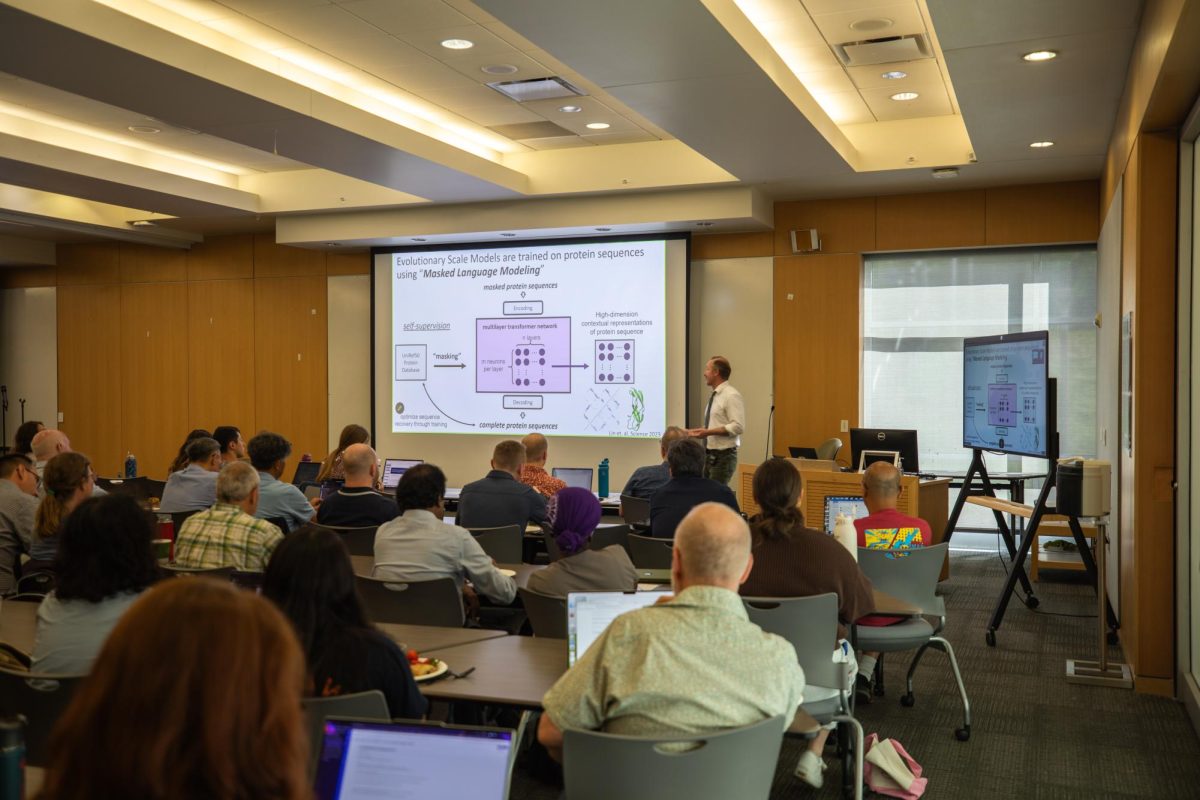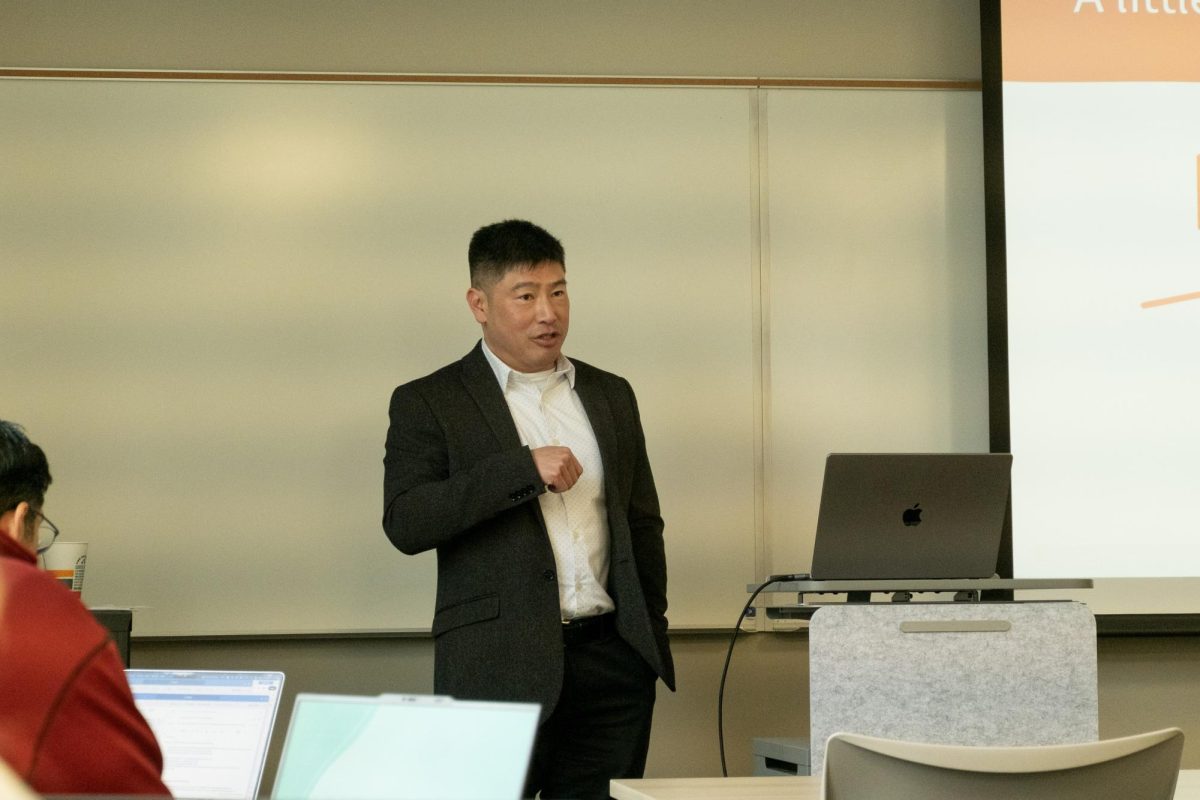
Victor Lee, associate professor at Stanford University, spoke about artificial intelligence in a presentation in the L.S. Skaggs Applied Science Building on Friday, Jan. 23. Lee, who works in the Graduate School of Education, was invited to present in this year’s Hugo Rossi Lecture Series, which was created to connect the College of Science and the College of Education through research.
Lee discussed the importance of understanding and implementing AI literacy within education, particularly within STEM fields. “[AI is] a tool. We should know how to use tools, but we should also know how to use tools responsibly,” he said.
The main problem
Lee said there is no clearly defined understanding of AI literacy, despite the Trump Administration’s efforts to promote it in the education system. “It is the policy of the United States to promote AI literacy and proficiency among Americans by promoting the appropriate integration of AI into education,” according to an executive order from April 2025.
“But where do we position ‘AI literacy’?” Lee asked. He identified several qualities that can define digital literacy, such as perception, representation, reasoning, interaction and impact. Lee categorized these as being from a user, developer or critic’s perspective, saying it is important to balance and present all three perspectives.
He also said there is not enough time to create precise benchmarks of AI literacy, considering how rapidly AI technologies have been developing. “We have an imperative to develop AI literacy, whatever it is, now.”
Lee said he believes the solution is in bringing “education expertise to interface with STEM expertise.” He said he thinks it leads to better outcomes than AI-specific curriculums.
Possible solutions in education
Lee presented two Stanford-based projects that would help strengthen AI education in middle and high school education.
In collaboration with Google, his team developed a quest-based videogame that teaches the “fundamentals of AI” to students aged 11 to 14. Called AI Quest, the project was created to promote the user, developer and critic’s perspective while using real-world applications of AI, including flood forecasting and blindness prevention. “We want it to present complexity in simple and relatable ways,” Lee said.
AI Quest uses “pedagogical agents” to teach basic concepts of data collection, data cleaning, interpretation, accuracy and application, he said. He described these agents as “specialized kinds of characters in online experiences that … are designed specifically to provide scaffolding, tutoring, or other forms of guidance.”
The game also has “teachable agents,” whose questions about AI and data the student must answer. The self-explanation effect strengthens the students’ understanding of AI and data practices, said Lee.
Lee’s team at Stanford also designed an initiative to “help [high school] students explore, understand, question, and critique AI.” The project is called CRAFT, Classroom-Ready Resources About AI For Teaching. It applies a multidisciplinary approach to education, allowing teachers and students in all areas can use it.
Schools do not have time “to just teach AI as its own subject,” said Lee. “But rather, you can teach about how AI is … connected to [biology], how AI is connected to math, how AI is connected to art.”
He concluded that an important step in the process of developing AI education is to have open conversation between students and educators about AI and its appropriate uses. “[AI literacy is] a giant collective effort that we do one conversation at a time,” he said.